
4 min read

Building a business can teach you a lot of skills: how to negotiate contracts, gain a competitive edge, or market your product, among others. But when you work in a team, you may be confronted with a new set of challenges: how to nurture a sense of meaning and encouragement among your employees and allow them to achieve their best productive potential.
There is an undeniable truth in the common adage that a brand is only as good as its people. After all, your business might look good on paper, but you cannot execute your ideas alone. In order to scale and build your brand, you need to surround yourself with the right people that understand your brand positioning, resonate with your values, and can pull off your strategies.
Yet to get this right, you need to turn your business into a talent magnet. In other words, you need to invest in employer branding. Read on to uncover the importance of employer branding and how you can build an employer branding strategy.
What Is Employer Branding?
By now, you know a lot about branding your business and how it helps you build a loyal customer base and a strong market presence. If your branding revolves around the customers’ perception of your products and services in the marketplace, your employer branding revolves solely around your image as an employer. In short, it’s the promise you make to your employees in exchange for their talent and contribution to your business.
If you think that employer branding is simply a nice-to-have initiative, here are some interesting statistics that reveal why employer branding is more important than ever:
- 75% of candidates will take into account brand reputation before submitting their application
- 92% of employees would be willing to change jobs if they had the chance to work for a company with an excellent reputation
- Investing in employer branding could reduce turnover by 28% and cost per hire by 50%
To get started on your employer branding efforts, you need to align your brand values and mission with the aspirations of the employees you would like to work for your brand. By communicating what your brand stands for, you can streamline the recruitment process and improve employee engagement and retention. Now let’s delve into the employer branding strategy that could help you reap these benefits.
Your Employer Branding Strategy for Success
Understanding the importance of employer branding is nothing without a solid strategy that can actually help you get results. Adopting a strategic approach can help you monitor and change the conversation surrounding your brand. In turn, this will help you acquire and retain top talent.
There are two sides to employer branding: how you market your brand to potential employees and what current employees have to say about your work environment. Let’s explore how you can nurture both sides in order to achieve the best results.
Step 1: Start with an Employer Brand Audit
When it comes to your employer branding, what you don’t know can hurt you. Understanding your current brand reputation among employees and prospects is essential to gauge what the market expects and how you can rise to the occasion.
To this end, conduct internal surveys, look up your brand on social media, read employee reviews, or hire a third-party company that can help you with reputation management. This research should help you identify what stands out in the eyes of your employees and what aspects you should improve in the future to consolidate your employer brand.
Step 2: Establish Your Employer Value Proposition
The employer value proposition is the statement that defines what you are willing to provide to your employees in exchange for their skills, dedication, and experiences. To this end, it should be true and undisputed by your employees. Once you have identified your employer value proposition, you can showcase it on your platforms and highlight it in your recruitment offers.
Be mindful that your employee value proposition does not revolve around the compensation package. Instead, you should highlight your brand’s purpose and how it adds value to the market. This will help employees and prospects understand that their work is meaningful and has a bigger contribution to the world.
For example, ESG ratings firm Sustainalytics has the following message on their careers page: “Join our awesome team and contribute to a more sustainable future.” As a result, they rely on the promise of a more sustainable future to build their team.
Step 3: Highlight Existing Employees
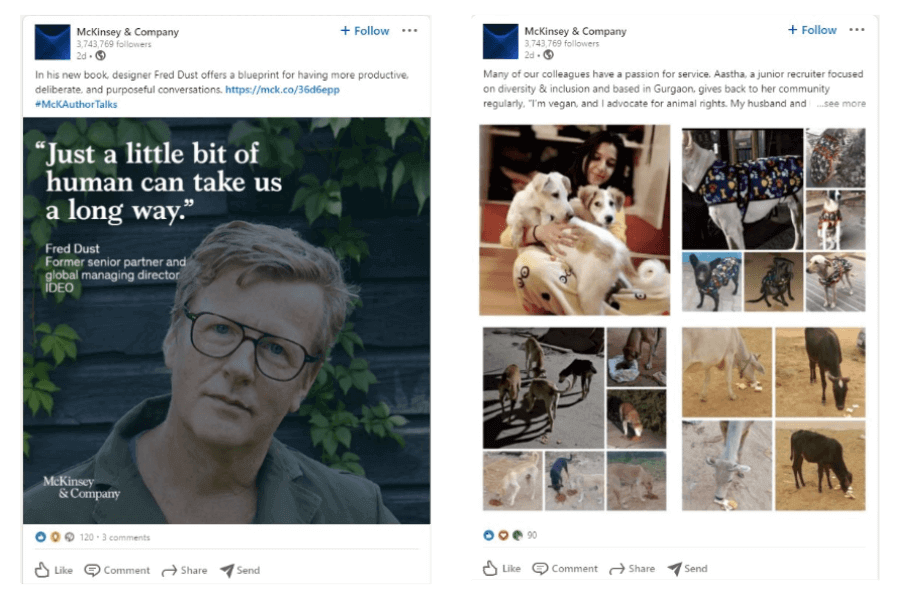
Nothing helps you communicate your employee branding efforts better than existing employees. To highlight their experience at your company, you can conduct employee interviews and testimonials that you can later showcase on your website.
Moreover, you can also leverage the power of social media to describe the employee experience at your company. You can post employee highlights, social events, volunteer opportunities, or internal initiatives that are consistent with your employer value proposition.
Alternatively, you can create a unique hashtag and encourage your employees to post about their daily routines at your company. Sharing these experiences with their own networks can help spread the word about your promise as an employer and help you hire top talent faster.
Source: image
Example: McKinsey’s social media post about their employee
Step 4: Infuse Your Brand Story in All Branding Materials
You already know that consistency is key in all branding initiatives. Whether you are branding your product or your employer perception, you cannot do it on just one channel. You need to leverage all platforms and touchpoints in order to make sure that you reach the right audience and your message will be remembered.
And this message needs to be consistent with your brand story. After all, you cannot use a different set of branding elements in your employer branding efforts. So no matter where or how you showcase your employer value proposition, make sure it is consistent with your overall branding strategy and makes use of videos, photos, slideshows, blogs, and other tactics that will get your message across effectively.
Turning Employees into Brand Advocates
If we acknowledge that a brand is only as good as its people, then you know that your people come first. An employer branding strategy might help you in your recruitment and retention efforts, but only as long as you keep it up to date. If your employees fail to resonate with your employer value proposition or do not engage with your HR initiatives, you know it’s time to go back to step one and conduct an employer brand audit again.

Source: image
Example: Netflix has built a binge-worthy employer brand from the ground up. Known as WeAreNetflix.
Revising and refining your employer branding could help you turn employees into brand advocates and ultimately strengthen your brand. If you have a solid team dedicated to your brand growth, there is nothing you cannot achieve.
The Xara branding hub
Whether you want to grasp the basics of branding for your new business, want to work on your brand strategy, are stuck with your brand visuals or want to find branding tips on how to grow your business, check out:
- Foundations — Learn the basics of branding
- Strategy — Plan your brand strategy
- Build Story — Build a brand 1: Your brand story
- Build Visuals — Build a brand 2: Your brand visuals
- Management — Control your brand: Brand management
- Growth — Grow your brand: Brand marketing
- Improvement — Improve your brand: The rebrand
- Measurement — Measure your brand: Brand analytics and KPIs