TL;DR: Social media works for real estate agents when it does one job: making you the familiar, trusted name in your local real estate market before someone is ready to move. This hub walks through the decisions behind a marketing strategy, from audience to platforms to rhythm, and links to the guides, templates and ideas for each part.
Five decisions shape everything else in your social media marketing:
- Who you want to reach. Buyers, homeowners, people relocating or past clients.
- Why they should follow you. The knowledge only you can share.
- Where you’ll reach them. Platforms chosen by where your audience spends time.
- How you’ll keep it going. What you do yourself and what you hand off.
- How you’ll know it’s working. Conversations, inquiries and referrals.
Start here: find the right guide for where you are
Pick the row that matches where you are.
| If you want to | Start with | Then read |
|---|---|---|
| Know what to post | What to post | Content strategies for real estate |
| Get a ready-made month | The 30-day calendar | How to build a calendar with AI |
| Choose your platforms | The platform section below | The Facebook guide |
| See the bigger picture | The nine-step approach | 14 ways to get noticed |
| Hand off the repeatable work | Social Media Manager | Automated marketing for real estate |
What social media should actually do for a real estate agent

Picture someone thinking about selling who isn’t ready to call anyone yet. For months they see your posts, and by the time they’re ready, they already know how you work.
That’s the job of social media for a business built on trust and referrals: when a friend asks for an agent’s name, yours is already familiar.
The benefits of social media for a real estate business
Done well, it does three things, and none of them shows up neatly in a lead report.
- Familiarity. People who see your name every week feel they know you before the first call.
- Credibility. A market update with your own take shows potential clients you know the area.
- Referrals. Past clients and neighbors remember you when a friend asks for a recommendation.
Social media supports lead generation for agents as a long game, and brand awareness is too vague a goal for most agents to plan around.
How social media fits into your real estate marketing plan
It’s the part of your real estate marketing that works between transactions, while you run the rest of your business, so it needs its own social media strategy that doesn’t wait for a new listing.
For the wider picture, see our nine-step approach and these 14 ways to get noticed.
Where listings fit without taking over
A feed of only Just Listed and Just Sold reads like a billboard.
A starting ratio you can work with is one listing post for every three or four others.
Listing posts earn their place when they say something the MLS description doesn’t. Open houses, price changes and sold announcements each give you a natural post.
Know who you’re talking to

Buyers and sellers want different things: a first-time buyer, a long-time homeowner and someone relocating each need something else, and a post written for everyone says very little.
Write down the last five questions people asked you about buying, selling or living in your area. That list shows your target audience and your first posts.
Build your social media strategy around five content pillars
Content pillars are the recurring categories your posts fall into, and five cover almost everything for most real estate professionals.
| Pillar | The job it does | Example | Fits best on |
|---|---|---|---|
| Expertise | Shows how you work and think | What you check at a showing | Facebook, LinkedIn |
| Local knowledge | Proves you know the area | A new café, a school change | Facebook, Instagram |
| Buyer and seller questions | Answers what people ask | Pre-approval vs. pre-qualification | Facebook, Instagram, LinkedIn |
| Market context | Explains what the numbers mean | Inventory change, with your take | Facebook, LinkedIn |
| Listings | Gives people something to act on | The detail photos can’t show | Instagram, Facebook |
Expertise: show how you think
Share how you price a home, what you check at a showing or a lesson from a negotiation. Nobody else can post it.
Local knowledge: prove you know the area
New businesses, school changes, this weekend’s event: local posts show potential clients you know the community. Keep descriptions factual and inclusive, since Fair Housing rules cover housing-related posts.
Buyer and seller questions: answer what you already get asked
Anything you’ve explained three times to clients, buyers or sellers is a post. It’s how you become the source of expert advice in your area.
Market context: explain what the numbers mean
Share one number from your MLS, what changed and what you’d do about it, and keep it local.
Listings: give people something to act on
Give each one a reason to be read: the logic behind the price, or a detail the photos can’t show.
For ideas inside each pillar, see our article on what real estate agents should post on social media, with 59 post ideas beyond listings, and these content strategies for real estate. The 30-day calendar turns those content ideas into a schedule.
One test for every post: could anyone in the country have written it?
Generic: “Thinking of buying a home? Contact me today for expert guidance!”
Specific: “A buyer asked me this week whether they need a full 20% down before speaking to a lender. The answer depends on the loan. Here’s where I’d start.”

A guide to choosing social media platforms
Two active accounts beat five thin ones. Pick the platform where your audience already spends time, from the social media channels you can keep up. Pew Research’s 2025 survey of social media use found that 84% of U.S. adults use YouTube, 71% Facebook and 50% Instagram, with TikTok at 37% and X at 21%.
Social media platforms do different jobs, so the same idea changes shape on each. A market update gets a longer explanation on Facebook, a carousel on Instagram and the professional takeaway on LinkedIn.
Facebook: the local platform for a realtor
Facebook suits local conversation with past clients, neighbors and community groups, plus events. Facebook for realtors works best as a conversation, so a real estate Facebook post with your take beats a bare link. Our guide to Facebook for real estate agents covers what to post and a weekly rhythm, and there are templates and an article on paid ads. Paid advertising is a separate decision from organic posting.
Instagram: the visual platform
Instagram suits homes, neighborhoods and behind-the-scenes content, and it reaches more younger buyers: a single Instagram post can carry a house’s five best photos, and Instagram Stories can count down to an open house. The Instagram templates give you a starting design.
LinkedIn: the referral platform for realtors
LinkedIn is where lenders, title companies, inspectors and other real estate professionals are, so it works best for referrals. Share local analysis and industry news, with these templates for visuals.
YouTube and Pinterest: the search-driven platforms
YouTube and Pinterest work like search engines, and both can send website traffic back to you. Add one as a third platform once two others are running, with our tips for video and photography.
Twitter (X) and TikTok: when to skip
Twitter, now X, rarely pays off for local real estate, and Pew puts its U.S. usage at 21%. TikTok has reach with younger buyers but needs regular video, and NAR’s 2026 Member Profile puts TikTok use among REALTORS® at about 16%. Not every one of the social media sites is worth your time.
Cadence and consistency: a plan for your first month
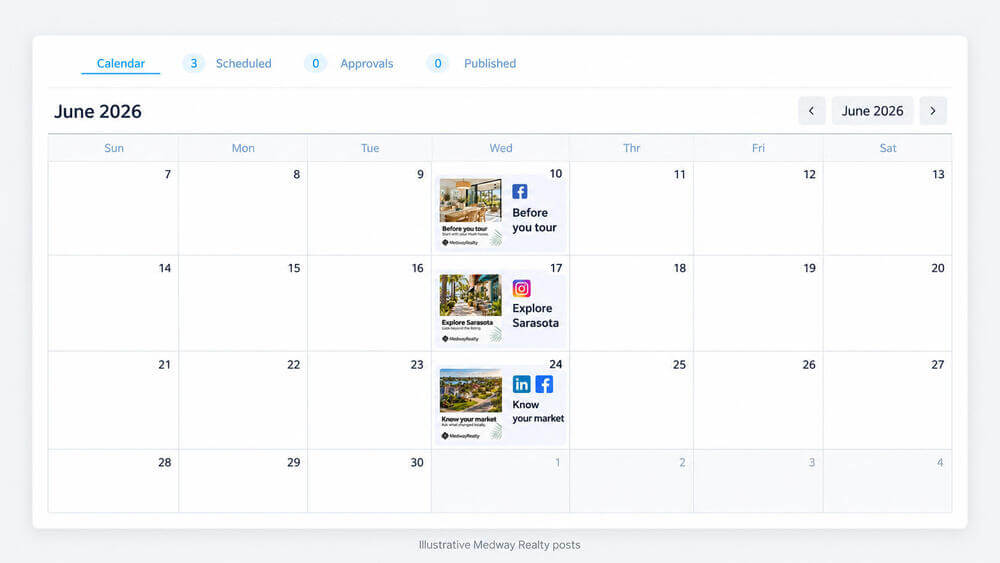
A realistic rhythm to get started is three posts a week on your main platform, one on the second and ten minutes a day replying.
- Week one: pick two platforms, write down your five pillars and draft a week of posts.
- Week two: share one post from each of three pillars and reply to everything.
- Week three: turn one idea into several, such as a post, a carousel and a LinkedIn note.
- Week four: see which pillar earned the most replies and saves, and adjust.
Batch the work in one hour a week, and set a floor you’ll keep even in a bad week. Use the 30-day calendar for ready-made ideas, or see how to build a calendar with AI.
How content builds visibility and trust

People who get your name from a neighbor will often look you up before calling, and your social media presence either confirms the recommendation or undermines it.
Repetition, proof and response do the work: a steady stream of useful social media posts, specific local real estate content and prompt replies to potential customers. None of it produces an instant inquiry, but it builds the kind of real estate brand people recommend across all your social media accounts and profiles. For search, see SEO for real estate.
Manual management vs. support and automation
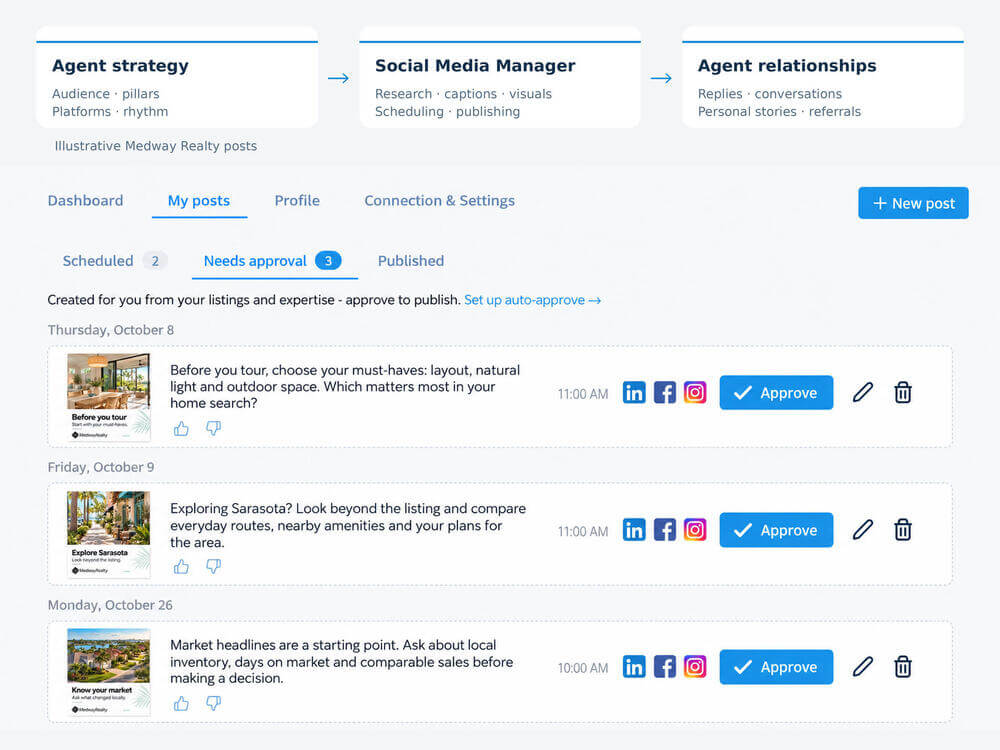
You can run all of this by hand, hire a freelancer or marketing agency, or hand off the repeatable parts.
What to keep human
Replies, stories, opinions and the photos and videos you take at a property: the parts that need a real person.
What to hand off
Topic research, captions, graphics and scheduling: the repeatable digital marketing work behind most social media content, and the part that keeps you from running your business.
Xara’s Social Media Manager takes that on. You decide your pillars, platforms and rhythm.
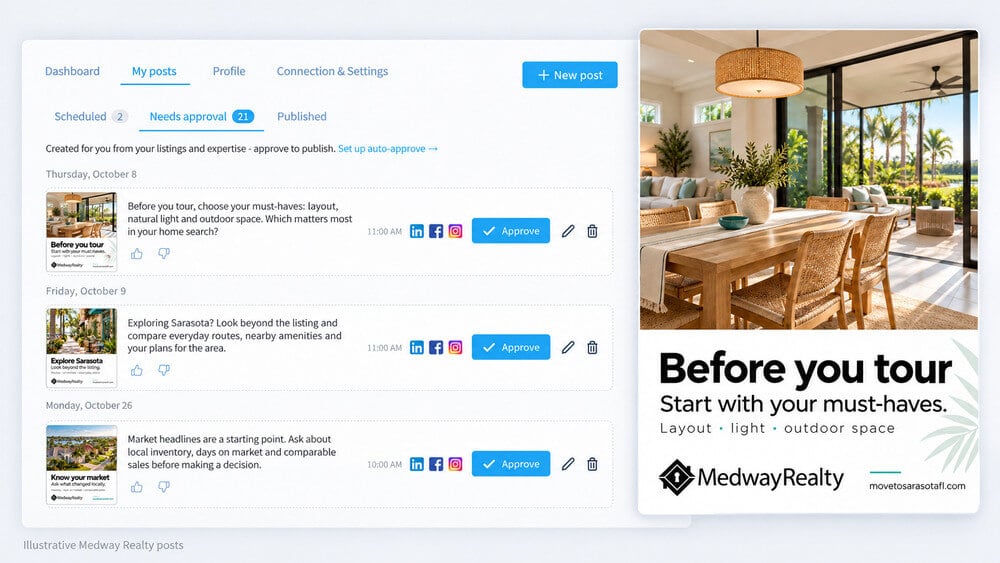
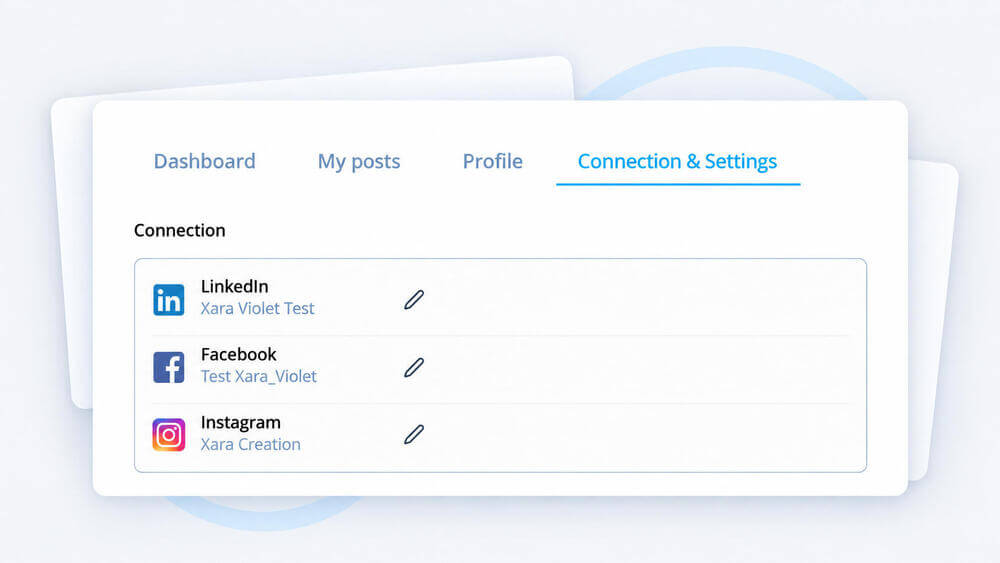
It researches topics from your market, audience, listings and brand, writes the captions, creates the visuals and schedules posts to Facebook, Instagram and LinkedIn, with your approval or automatically.
Xara already posts when a home’s status changes, and Social Media Manager covers the weeks in between. Your strategy and your conversations stay yours. For more, see what automated real estate marketing is.
How to measure social media marketing
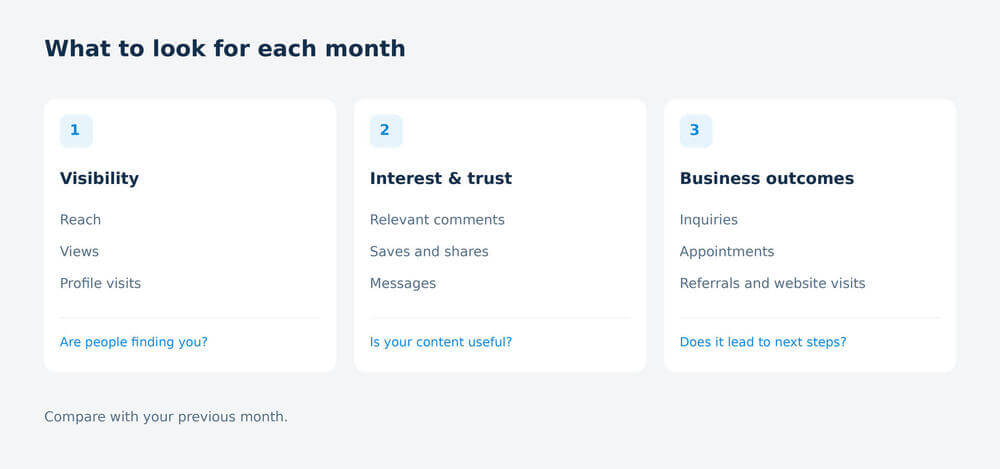
Measure usefulness before results, and review monthly.
| What to measure | Examples | What it tells you |
|---|---|---|
| Visibility | Reach, views, profile visits | Whether people are encountering your content |
| Interest and trust signals | Relevant comments, saves, shares, messages | Whether people engage with what you share |
| Business outcomes | Inquiries, appointments, referrals, website visits | Whether social media is leading to real next steps |
Compare yourself with last month, since published benchmarks measure different things.
Add tracked links to posts that point to your website, and ask every new client or inquiry how they found your business.
Social media for real estate agents: FAQs
Do you need social media as a real estate agent?
No rule says you must, but many future clients look you up online before calling, and 75% of REALTORS® used social media in their business in NAR’s 2025 survey. If you’re going to be there, have a purpose.
What is the best social media platform for real estate agents?
Facebook and Instagram are the strongest starting pair. Add LinkedIn if referrals matter, and treat YouTube, Pinterest and TikTok as extras. The best platform is the one where your clients are and your content is easy to produce.
What are some good social media posts for real estate agents?
Local updates with your own take, answers to buyer and seller questions, local news, client stories and property posts with one detail the photos can’t show. Our article on what to post has 59 more.
What is the 5-5-5 rule for social media?
There’s no single version. The popular real estate one asks for five posts, five comments and five story replies a day, which is one coach’s minimum with no research behind it. What’s worth keeping is that replies matter as much as posts.
More marketing ideas and guides for real estate agents
This hub is the strategy, and the library groups the rest of the Xara blog by goal. For more real estate marketing ideas beyond posting, start here.
The series
Start with these, which go deeper on what to post, when and where.
- What to post covers 59 ideas for every pillar.
- The 30-day calendar lays out 30 days of posts.
- The Facebook guide covers groups, ads and a weekly rhythm.
See the bigger picture
Use these when you’re planning marketing beyond social media.
- The nine-step approach runs from goals to content, video and email.
- 14 ways to get noticed mixes content, visuals and outreach.
Content and creative
Use these when you’re making the posts themselves.
- Content strategies for real estate covers blogs, video and local content.
- 12 tips for video and photography tips cover the assets.
- 37 ChatGPT prompts for real estate helps with drafting.
- 8 open house flyer ideas covers the print side.
Get found and get seen
Use these when you want more people to find you.
- The power of SEO for real estate turns listings into search traffic.
- Real estate ads: 17 examples and paid ads for real estate cover the paid side.
Automate the repeatable work
Use these when the weekly routine is the problem.
- Automated marketing for real estate explains what it is and how to do it right.
- Social Media Manager plans, creates and schedules posts to your connected platforms.


 No credit card or phone number required.