TL;DR: The best real estate lead generation ideas are the ones you can repeat, measure and improve. Here are 30 lead generation strategies, each with a first step and a metric.
Some months, real estate clients seem to find you on their own. A past client recommends you to a friend. Someone calls about a listing. A showing turns into a buyer consultation.
Then the inquiries slow down.
That’s the challenge with real estate lead generation: being good at your job doesn’t automatically mean having a steady pipeline of people who need your help.
Solving it takes a few reliable ways to meet potential clients in your real estate market, build trust locally and follow up when someone shows interest.
Below are 30 ideas you can put into practice, whether you’re a new agent building your network or an experienced agent who wants better results from the relationships you already have.
If you’re after the lead sources themselves, such as portals and purchased leads, our guide to generating real estate leads covers them in depth.
What actually generates real estate leads?
No single channel works best for every agent. In NAR’s 2025 REALTORS® Technology Survey, 39% of respondents named social media as the technology producing their highest number of quality leads, ahead of CRM systems at 23% and the local MLS at 17%.
The Real Brokerage’s April 2026 agent survey, with 569 responses from agents in the United States and Canada, asked a different question: which lead generation source works best. Of those agents, 60% named referrals and repeat clients, 17% named social media and 8% named online lead portals.
Each survey has limits, since one covers technology and the other covers agents at one brokerage network.
Together they suggest that most real estate agents build their lead generation efforts and their business from a mix, with relationships at the center and visibility around them. That matters when you decide where to spend your week.
How real estate lead generation works
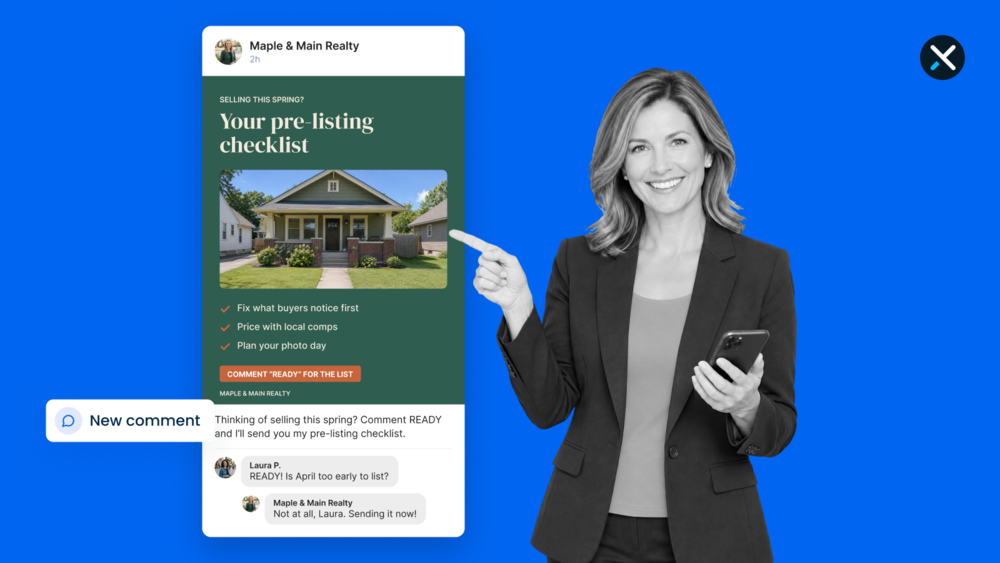
Every tactic here does some of the same four jobs, whatever the channel. It gets you noticed, captures a way to reach the person, keeps you useful until they are ready and turns a conversation into an appointment.
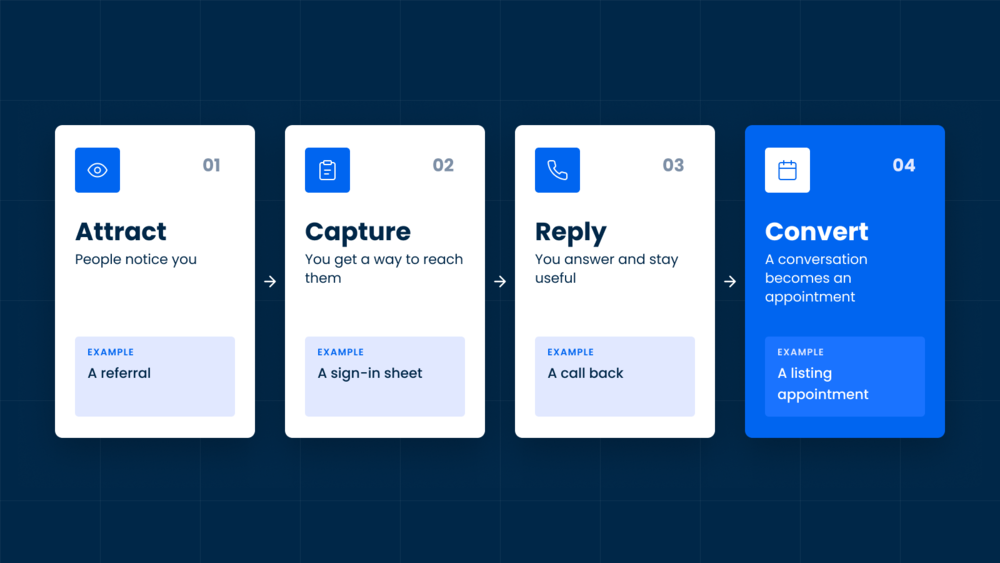
| Stage | What happens | Examples | Number to watch |
|---|---|---|---|
| Attract | People notice you | A referral, an open house, a search result, a post | Visits, sign-ins and profile views |
| Capture | You get a way to reach them | A form, a sign-in sheet, a direct message, a call | Contacts captured |
| Reply | You answer and stay useful | A call, an email, a short message | Response time |
| Convert | A conversation becomes an appointment | A buyer consultation or a listing appointment | Appointments and signed clients |
Most agents are strong at one stage and weak at another. Look for the gap in your own week first.
Three words this guide uses the same way throughout:
- Lead: someone who has shown interest and shared a way to reach them.
- Conversation: a two-way exchange with that person.
- Qualified opportunity: a conversation that points to a real need and a timeline, such as a buyer consultation or a listing appointment.
A short guide to picking your mix for real estate lead generation
Three inputs decide which lead generation tactics suit your real estate business: the time you can give each week, the marketing budget you can repeat and the number of people who already know you.
A workable pairing is one tactic that creates conversations and one that builds visibility. A referral partner meeting or hosting open houses starts conversations. Run the pair for a set period before adding a third. Two or three strategies done well beat ten done halfway.
| Your situation | Start with (numbers below) | Why |
|---|---|---|
| New agent, small contact list | Hosted showings, introductions and local content (16, 3, 8) | You need conversations and recognition |
| Experienced agent, large database | Past-client outreach, referrals and replies (1, 2, 28) | You already have relationships worth keeping warm |
| Strong local expertise | Neighborhood pages, Google presence and local posts (4, 5, 11) | Your knowledge gives people a reason to find you |
| Regular listings | Hosted showings, listing campaigns and property videos (16, 17, 18) | Each listing gives you a timely reason to contact people |
| A paid marketing budget | Search ads, social ads and portals (15, 23, 24) | You can test reach once your replies are reliable |
| A brokerage managing many agents | Shared content, brand rules and measurement (14, 17, 30) | Consistency gets harder as the team grows |
Real estate lead generation ideas for new agents
New agents have an empty database and no habits to lean on, so the first months depend on conversations you start yourself.
Three layers give a beginner a simple plan: the people you know, the places you show up and the skills you build.
Start with your sphere of influence

List everyone you know and tell each person you are in real estate, the area you serve and how you can help. Idea 1 has a script you can copy.
Host and attend open houses
Hosting open houses for busy colleagues gives new agents a chance to meet potential buyers face to face. Idea 16 covers the follow-up.
Choose a niche early
Pick a focus that makes every post and conversation more specific: first-time buyers, downsizers, one neighborhood or one price range. It is easier to remember an agent known for one thing.
Learn real estate prospecting basics
Prospecting means contacting people who might need an agent. Begin with warm contacts, learn the Do Not Call rules before you dial anyone and keep a log of every conversation. Idea 25 covers expired and for-sale-by-owner listings legally.
Real estate lead generation ideas for experienced agents
Experienced agents have the opposite problem: years of contacts and too little time to use them. Their gains often come from organizing what they already have.
Turn your database into a working system
Tag every contact with its source, its timeline and the last conversation, then set the next touch and review the list weekly. Idea 28 covers the reply routine.
Use analytics to find your best source
Once a quarter, list your last ten clients and where each one came from. Add the numbers from your website analytics and your platform insights, and look for the pattern.
Treat predictive analytics as a prompt
Some CRMs rank contacts by how likely they are to move. The scores are estimates, so treat them as a prompt to call and nothing more.
Real estate lead generation from people who already know you
Begin where the trust already exists.
Your sphere of influence can be a practical starting point, because these people already know you. It costs mostly time, which makes it the easiest place to test real estate lead generation.
1. Reactivate past clients and send home anniversary notes

Open your contacts and see who’s in there.
Past clients. Old inquiries. Neighbors. Business owners you’ve worked with.
Sort your sphere of influence into three piles: past clients, warm contacts and people you haven’t spoken to in years. Then send each pile one useful message, such as an offer to update their home’s value or a short note on what changed in the market.
New agents with a short list can keep it plain:
“I’ve started working in real estate in [your city]. I’m focusing on helping first-time buyers understand the process, so if you ever have a question about the market, feel free to ask.”
Add a note on each closing anniversary too, and reply to every answer within a day, because every reply is a possible lead.
- First step: export and sort your contacts this week and add every closing date to your calendar.
- Track: replies and conversations per message sent.
2. Ask for referrals at the right moment
Timing matters here.
Satisfied clients may know someone who needs a real estate agent. Ask when they’re happiest: after a smooth closing, a solved problem or a strong offer.
Then say exactly what you’d like:
“If a friend mentions moving, I’d love an introduction.”
Thank every referrer within a day, whether or not the introduction turns into business, and ask for a testimonial in the same conversation.
- First step: add a referral request to your closing checklist.
- Track: introductions received per closed client.
3. Build referral partnerships with local professionals
Lenders, inspectors, estate attorneys, financial planners and insurance agents each run a business that meets people at life events that often involve a move. Other real estate professionals, such as title officers and stagers, belong on the list too.
Pick five. Offer something useful first, like local market data for their clients or a joint marketing workshop, and keep a monthly touchpoint going.
One caution: referral and fee arrangements between professionals can be regulated, so check your state’s rules and your broker’s policy.
- First step: list ten local professionals and book two coffees.
- Track: introductions in both directions.
Online lead generation: be easy to find
Real estate buyers and sellers research before they call anyone, so your online presence often does its work before you meet them. Online lead generation starts there.
4. Complete your Google Business Profile and collect reviews
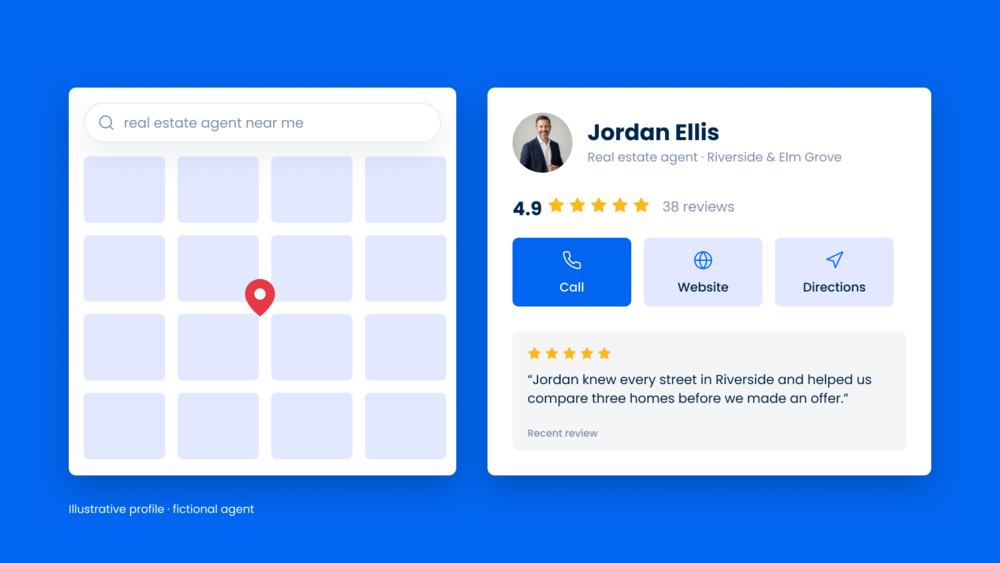
Picture someone searching for a real estate agent nearby.
The local map listing often appears before any website.
Claim your Google Business Profile, fill in every field and add photos. Then ask satisfied clients for a review on Google or your Zillow profile, in their own words, and reply to each one.
Respect their privacy and never script what they say. A steady stream of recent, genuine reviews helps a stranger decide to call.
- First step: claim and complete the profile today.
- Track: profile views, calls and new reviews each month.
5. Improve your agent websites and local SEO
Many sites are brochures with a phone number. A real estate website that answers local questions earns local SEO value over time.
Build a page for each area you serve, with typical price ranges, parks and schools, commute notes and recent sales in your own words. Keep descriptions factual and inclusive, because the Fair Housing rules from HUD apply to housing content.
Then look at two competing websites in your area and note what they answer that yours doesn’t. Give every page one visible way to reach your business, such as a short form or a click-to-call button.
- First step: write one page for your strongest area.
- Track: visits to the page and form submissions.
6. Start a real estate blog with real estate advice that answers questions
The questions clients ask you are searches other people type into Google.
Here’s a simple rhythm: pick one a week, such as what happens after an accepted offer or how to prepare a home for photos, and answer it in 400 to 800 words with a local example.
A blog builds slowly, so treat it as a base you add to for months. Real estate content that gives plain advice earns trust before the first call. For more post ideas, see our 59 posts beyond listings.
- First step: list your ten most-asked questions.
- Track: search visits and inquiries from those posts.
7. Run email marketing with a monthly or biweekly note
Email is the channel you own.
A short note with one local market observation, one home or neighborhood tip and a single reply prompt keeps past clients and prospects in touch. Include a clear unsubscribe link and your business address, as email rules require, and send only to people who have agreed to hear from you.
Email marketing rewards consistency far more than polish.
- First step: choose a send day and write the first issue.
- Track: replies and clicks.

Social lead generation that starts conversations
Social media marketing works as a long game. It makes you familiar to people who are not ready to call yet, so yours is the name they remember when they are.
The hard part is keeping it up. Posting well means finding time between showings, negotiations and closings, which is the recurring work Xara’s Social Media Manager takes on: it creates branded local content for your social profiles, and you review it or let it post automatically.
For the strategy behind these habits, see our social media hub.
8. Explain your market in one number
One number. One meaning. That’s the whole post.
Share one real estate statistic from your MLS, one sentence on what changed and one sentence on what it means for a buyer or seller of homes in your area. Add the reporting period, the area and the source, so the number carries context. If you would rather not build these from scratch, Xara’s Social Media Manager creates local market posts that you can review and edit before they go out.
Our 30-day calendar includes ready-made market update days.
- First step: pick the number you will report every month.
- Track: saves, replies and profile visits.
9. Answer client questions in short videos and carousels on Instagram
Your clients ask the same questions again and again.
Each one is a post waiting to happen.
A 45-second Reel or a five-slide carousel on one real estate question, such as what closing costs buyers should plan for, suits potential clients scrolling in the evening.
Give the answer first, add a local detail and end with one next step, such as “DM me CHECKLIST.” Our Instagram guide for real estate agents covers formats and captions in detail.
- First step: film your three most-asked questions this week.
- Track: saves, shares and direct messages.
10. Show how you work and tell client stories

People hire someone whose judgment they’ve already seen.
So show it. Film the one thing you check in a basement before a buyer falls for the kitchen, or what you look at in the first two minutes of a showing.
Add a real estate client story now and then: the seller who skipped an expensive renovation, the buyer who changed the search after three showings. Ask the client first, remove anything confidential and keep the lesson at the center.
- First step: record one clip at your next showing and ask your last happy client for permission to tell their story.
- Track: replies that mention it and referrals.
11. Spotlight neighborhoods and price points
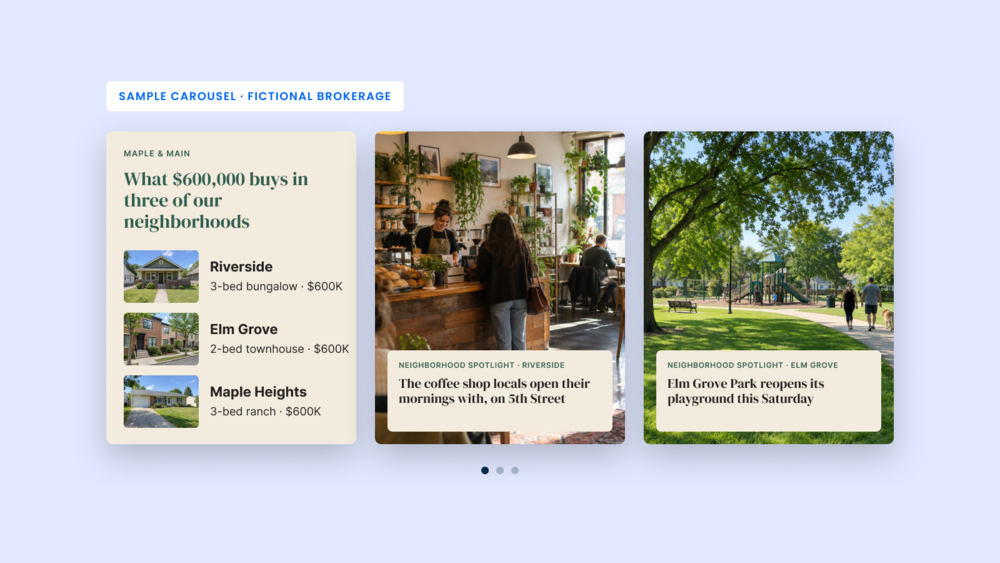
Try a post titled “What $600,000 buys in three of our neighborhoods.”
It gives potential clients a reason to save it, and it gives you a reason to talk about each area.
Show two or three homes at the price you name so the post has something concrete. Neighborhood spotlights work the same way: a community garden, a coffee shop, a park, a school change, the farmers market that moved. Tag the business and the location, and keep descriptions factual and inclusive here too.
- First step: draft one price-point post for your strongest area.
- Track: saves and profile visits.
12. Join local conversations and team up with local businesses
Local Facebook groups and community pages are full of potential clients asking for recommendations.
Answer the plumber question before you ever mention real estate. Read each group’s promotion rules, and let conversations move into direct messages on their own.
A joint post with a coffee shop, a lender, a stager or other real estate professionals also puts you in front of the partner’s followers. Get permission before you film or feature anyone, and tell people when a post is a partnership.
- First step: join two local groups and answer three questions this week.
- Track: direct messages that trace back to a conversation.
13. End every post with a way to start a conversation
A post that earns attention and offers no next step wastes it.
Give each post one invitation small enough that saying yes feels easy:
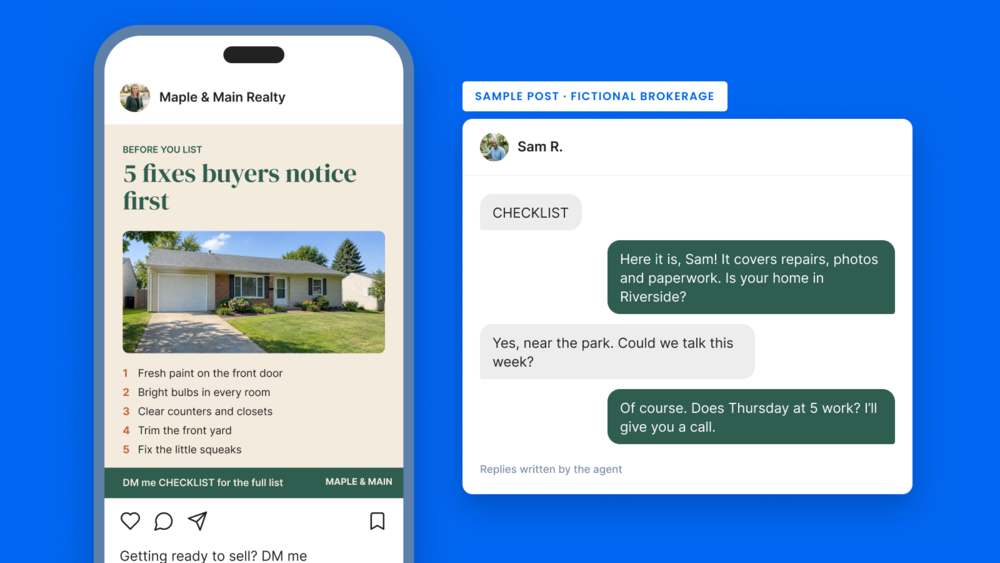
- A keyword to send: “DM me CHECKLIST and I’ll send my pre-listing checklist.”
- A question to answer: “Comment your neighborhood and I’ll share recent sales.”
- A page to visit with one short form.
- An event with a time and a reason to come.
Then do what you promised.
Reply the same day, answer the question before you ask one, send the checklist promptly and record where each lead came from. A conversation that stalls in the comments for a week often fades.
- First step: add one next step to your next three posts.
- Track: replies and direct messages per post.
14. Keep a posting routine through the weeks between listings
The weeks between listings are where most accounts fall silent.
A listing and two closings fill the calendar, the posts stop and the people who were starting to notice you forget.
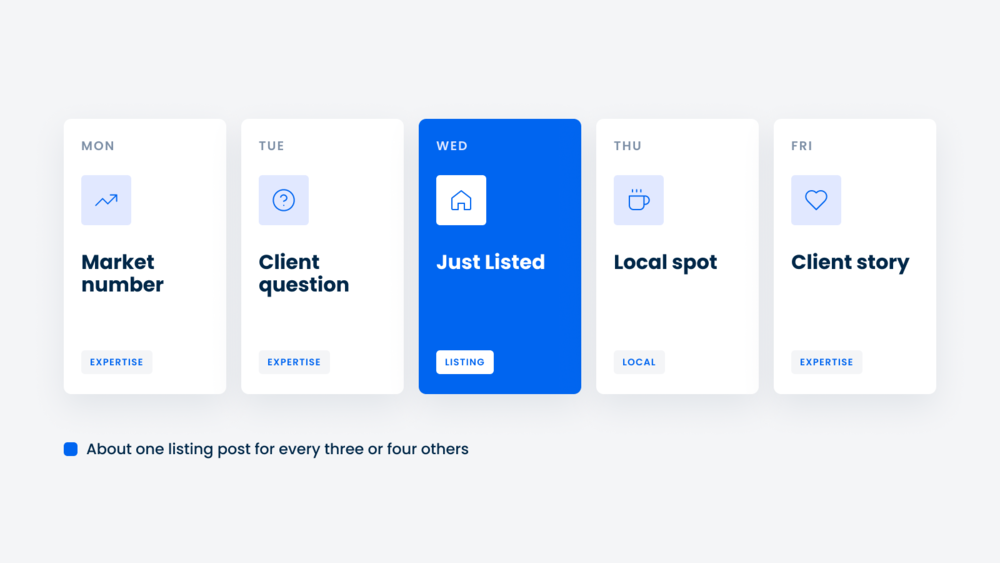
Three useful social media posts a week is a workable start: a real estate market number, an answer to a client question and a local spot, plus a listing or client story whenever you have one. Batch the work in one sitting so a busy week doesn’t erase the habit, and choose a rhythm that survives your busiest month in business.
This is the gap Xara’s AI Social Media Manager is built for: it keeps posts going in the weeks between transactions, and a brokerage sets brand rules once so every agent’s posts stay consistent.
- First step: block one hour a week for posts.
- Track: how many of the last twelve weeks you posted on schedule.
15. Use social media ads with Fair Housing in mind
Treat the marketing budget like any other business expense, with a review date.
A small, tested budget can promote an upcoming showing, a seller offer or a buyer checklist to potential clients nearby. Housing ads carry special targeting limits, so read Meta’s housing ad rules and HUD’s guidance before you build anything, and write your reply plan before you buy traffic.
Our article on real estate Facebook ads covers formats and rules.
- First step: write the reply message before launching.
- Track: cost per qualified conversation, since clicks alone say little.
Lead generation from listings and events
Properties on the market give you natural reasons to reach out, such as a new home on the street, an event or a price change.
Used well, each one starts a conversation with a neighbor or a potential client.
16. Treat every open house as a seller and neighbor event
Promote each event to the surrounding community. Neighbors often arrive curious about what the home down the street sold for, and some are thinking of selling themselves.
Collect names with a sign-in sheet or app that records interest and timeline, and contact everyone the same evening.
- First step: volunteer to host a colleague’s showing.
- Track: sign-ins and conversations afterward.
17. Promote each listing milestone and mix it with local content
Just Listed, Open House, Price Reduction, Under Contract and Just Sold are natural reasons to contact neighbors and your sphere.
Listing posts give people something to act on, and expertise and local posts give them a reason to trust the agent posting. Each needs the other.
A stream of only Just Listed and Just Sold graphics reads like a billboard. A useful starting rule is one listing post for every three or four others.
Done by hand, each milestone is a small design, posting and marketing job that slips when you’re busy. Xara’s listing marketing creates campaigns for these moments across social, email and print when a listing’s status changes.
- First step: list the milestones you promote every time and the ones you skip.
- Track: replies to neighbor-facing posts and mailers.
18. Use video marketing and virtual property tours
Video lets buyers outside your area see homes before they travel.
A steady phone walkthrough of the best room, or a virtual walk-through for out-of-town buyers, answers a question many buyers have: what does it feel like inside?
- First step: film a one-room walkthrough of your next listing.
- Track: watch time and showing requests.
19. Farm a small area with trackable direct mail
Choose a neighborhood sized to a mailing budget you can repeat. Then mail on a schedule: a market snapshot, a new listing, a just-sold card or an event invitation.
Add a QR code that points to a dedicated page, so you can see which piece prompted a visit. Judge farming and other direct mail marketing over a review period you set in advance.
- First step: pick the smallest farm you can reach consistently.
- Track: scans, calls and conversations per mailing.
20. Show up at community events
A farmers-market table, a sponsored youth team or a neighborhood cleanup puts your real estate name where the community already spends time.
Attend in person and offer something useful to the community, such as a free home-value lookup or a short local resource.
- First step: attend one recurring community event as a guest.
- Track: conversations and contact details collected.
21. Host first-time homebuyer seminars and online webinars
Walk attendees through the steps of buying or selling homes, from pre-approval to closing, and answer questions live.
Hosting the session online reaches people who cannot attend an evening event, and a recording gives you reusable content. Contact every registrant afterward, whether or not they attended.
- First step: pick a topic and a date this month.
- Track: registrations and conversations afterward.
22. Run client appreciation events
Realtors who host one event a year give their clients and their community a reason to invite friends they haven’t met yet.
- First step: choose a date and a venue for one event this quarter.
- Track: new faces and referrals afterward.
Paid and outsourced lead generation strategies
Paid options buy attention, or access to people who are already searching.
Treat each one as a test with a budget and a review date, like any other business expense.
23. Advertise with Google Ads and Local Services Ads
Search ads put you in front of people actively looking for a real estate agent in your market.
Here are the ground rules. Limit your ads to the areas you serve, check which formats and categories are available to you locally and estimate your monthly spend, as you would for any business cost, before you launch. Send each click to a page with one clear action, and answer new inquiries promptly.
A good first test for your business is one narrow Google Ads campaign for a single neighborhood.
- First step: check local keyword costs.
- Track: cost per inquiry and per appointment.
24. Evaluate Zillow and other portals as defined tests
Zillow and similar portals sell access to consumers already in the real estate market, with pricing, lead sharing and fees that vary by area.
Before you sign with Zillow or any other portal, ask whether buyer leads are exclusive or shared, whether a lead can be disputed, how the fee is calculated, including any referral fee at closing, and what cancellation requires.
- First step: request current local terms in writing.
- Track: cost per closed client, which tells you more than cost per lead.
25. Contact expired and for-sale-by-owner listings legally
Owners of expired and for-sale-by-owner listings have already shown they want to sell, which also means many agents call them. Lead with a real diagnosis of why the home did not sell.
Prospecting by phone or text is regulated by national Do Not Call rules, state registries and consent requirements. Anyone new to prospecting should read the FTC’s Telemarketing Sales Rule guidance and confirm the process with their broker first.
- First step: document your calling and follow-up process.
- Track: conversations and listing appointments per 100 contacts.
Niche strategies for real estate agents who know a local market
A niche makes every post and conversation more specific. These two reward agents who publish local data and answer specific questions.
26. Create investment and rental content for real estate investors
Investment buyers search for rental properties, typical rents and neighborhood trends.
Publish local data on rents and sale prices, explain what makes a property a fit for a buyer’s criteria and offer a short checklist for first-time landlords. Keep investment advice for licensed professionals and avoid promising returns.
Investors often know other investors, so each good conversation can lead to the next.
- First step: publish one local rental market summary.
- Track: replies from investors and landlords.
27. Connect with relocation services and employers
Corporate human resources teams, local employers and relocation companies help people who are moving to your area, and NAR suggests reaching out to HR departments for that reason.
Offer a short local overview covering neighborhoods, commute times and schools, and ask to be listed as a resource.
- First step: email two local employers with your relocation overview.
- Track: introductions and overview requests.
Lead generation tools for realtors: capture, reply and save time
Collecting interest is only half of lead generation. The other half is replying quickly and keeping every lead warm until the person is ready.
These follow-up strategies decide whether the rest pays off.
28. Build one capture page and a same-day reply routine
Every tactic above fails if a lead sits unanswered.

The fix is simple. Give each campaign one landing page with one offer, such as a home-value estimate or a buyer checklist, and treat it as a lead magnet: something useful enough that a person trades a name and an email for it.
Record where each lead came from, so you can funnel leads into the right follow-up and later measure real estate lead conversion by source.
A lead that comes from a referral can behave differently from a lead that comes from a form, so treat each one like a person with a question.
A tidy real estate database is most of a lead generation system, and noting which prospects replied fastest shows you where to spend your time.
- First step: choose one question your offer will answer.
- Track: form submissions and the source of each one.
29. Automate follow-up and email campaigns
Email marketing is the easiest place to automate, because the messages repeat.
Settle this before the first inquiry arrives: decide who answers each inquiry, through which channel and how fast.
Let software handle the routine parts: a thank-you message, a first reply and a few helpful emails, such as personalized property recommendations for real estate buyers. Respond promptly to each lead, and check that every automated message still matches what the contact asked for and agreed to.
- First step: submit your own form and time the response.
- Track: response time and the share of inquiries that become conversations.
30. Let AI draft the first version, then add what only you know
AI writing tools can draft a market update, a caption, a reply to a common question or the first version of a neighborhood page in minutes.
Give it your local numbers, your listing details and your own phrasing. Then check every fact, price and rule before anything goes out.
Keep your personal replies in your own voice, and follow your brokerage’s and each platform’s disclosure rules.
- First step: take one answer you give clients often, ask a tool for a draft and rewrite it with a local detail.
- Track: the time you save per post and whether the edited posts earn more replies than the generic ones.
Your first 30 days: turn these tactics into a routine
You do not need to launch ten new campaigns next week. Pick two tactics and give them a month.
| Week | Focus | What to do | What success looks like |
|---|---|---|---|
| 1 | Fix the basics | Check your contact forms, organize your CRM and choose two tactics | Every inquiry has an owner and a next step |
| 2 | Begin conversations | Reconnect with contacts, host a showing or meet referral partners | You are having relevant conversations |
| 3 | Build visibility | Publish useful local content or improve one page | People have a reason to find and remember you |
| 4 | Review and adjust | Record replies, inquiries, appointments, costs and time spent | You know what to repeat or change |
A simple weekly routine
For an agent with limited time and a modest budget, a workable first experiment might be:
- Reconnect with five relevant contacts.
- Publish two useful local posts.
- Attend or host one relationship-building event.
- Check inquiries and replies twice.
- Record where each new conversation came from.
These are suggested activities with no benchmark or lead target behind them. If the routine is too demanding, shrink it, because a plan you can keep in a busy month beats one you drop after two weeks.
How to measure your real estate lead generation
Set aside 15 minutes once a month and write down the same four things every time, so you can see how your business is trending across months. Count conversations before likes.

A like or a follower costs the person nothing and says little, while a reply, a call, a sign-in or a referral costs them effort and says far more. Judge each lead generation tactic by the conversations it produced, using the three definitions above.
| What to record | Where to find it |
|---|---|
| Replies and direct messages that started a conversation | Your inbox and comments |
| Inquiries, appointments and referrals | Your CRM or a simple notebook |
| How each new client found you | Ask every one, every time |
| Hours and marketing money spent on each tactic | Your calendar and your card statement |
At each review date, keep the strategies your records support, adjust the weakest step in anything promising and drop what produced neither conversations nor learning.
Calculate cost per acquired client
For paid tactics, a useful calculation is:
Cost per acquired client = total campaign cost ÷ clients acquired from the campaign
If you spend $600 on a campaign and acquire two clients you can reasonably credit to it, your advertising cost per acquired client is $300. That figure leaves out your time and other overhead, so include them when you compare tactics.
Until a campaign produces a client, track qualified inquiries and appointments, and keep them separate from revenue.
Accept imperfect attribution
A seller might see your neighborhood posts for months, read a review and then call after a friend’s recommendation.
Ask every client how they found you and record more than one touchpoint when it applies. The goal is better decisions, and a single post will rarely deserve all the credit.
Example: a 30-day test of two tactics
Here’s how that looks in practice. An agent picks two tactics from this guide: past-client outreach and local social posts. The numbers below are made up to show the method, and they are not benchmarks.
| Tactic | What the agent did | Conversations | Appointments |
|---|---|---|---|
| Past-client outreach | 20 personal messages and 2 coffees | 6 | 2 |
| Local social posts | 8 posts, each with one next step | 3 | 0 |
After 30 days the agent keeps both, because each one produced conversations and at least one lead. The outreach clearly earned its time.
The posts need a stronger next step before they get judged, so month two tests a keyword offer in every post, followed by another review.
Bottom line: nothing here guarantees a real estate lead, and anyone who promises one is guessing. What consistency does is more modest and more useful: it raises the chance that when someone is ready, yours is the name they already know.
Where Xara’s AI Social Media Manager fits
Most real estate agents have plenty to say. Finding the time to turn it into useful content is the hard part.
A buyer asks a question you could answer in a post.
The local market shifts and there’s an update worth sharing.
A new listing arrives, followed by an open house and a price change.
Each one is a chance to build trust with people in your local real estate market. But when your week fills with showings, negotiations and client calls, creating the content often gets pushed aside.
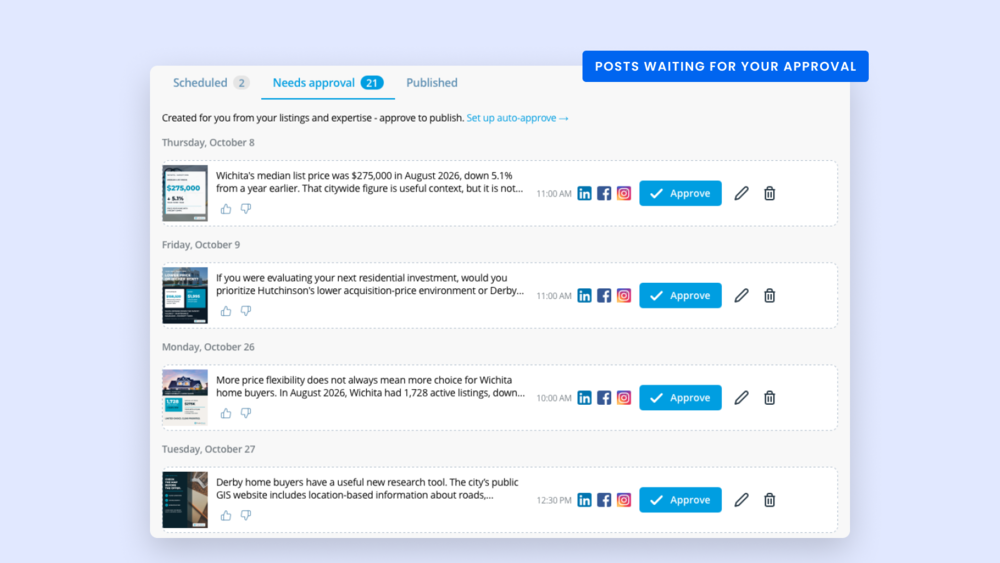
Xara’s AI Social Media Manager handles that recurring work. It creates branded local market content, neighborhood information and buyer and seller education for Facebook, Instagram and LinkedIn.
It also works alongside Xara’s listing marketing, so listing campaigns and everyday posts share one routine.
You can review and edit posts before publishing or choose automatic posting. Brokerages can keep branding consistent across their teams.
Xara doesn’t replace professional relationships or guarantee leads. It keeps your marketing active so potential clients have more chances to see your expertise.
Conversations, inquiries and follow-up stay with you.
What does this look like for real estate teams?
Broker Associate Shawna H. wrote in her G2 review, which appears on Xara’s customer stories page:
“Xara supercharged my real estate social media engagement and branding.”
That’s one customer’s experience, and results vary for every agent.
For a brokerage view, Collier & Associates has more than 250 agents in Northwest Arkansas.
According to its customer story, about 1 in 3 Price Improvement and Under Contract campaigns and more than 1 in 5 Open House campaigns are posted automatically to agents’ social profiles. At Westgate Realty, which equips 60 agents with custom content every day, the marketing team saves 80 hours a month.
These figures cover listing marketing at each brokerage and make no claim about lead counts.
Real estate lead generation FAQs
What is the best way to generate leads in real estate?
No single source wins in every market. Look at where your last five real estate clients came from, strengthen that channel first, then add one adjacent experiment.
The NAR and Real Brokerage surveys point the same way: a mix, with relationships at the center.
What is the 3-3-3 rule in real estate?
There is no single official version. One widely reported version, covered by RISMedia and Florida Realtors, asks agents to call three people, send three handwritten notes and share three useful resources each month.
What is the biggest mistake in lead generation?
Collecting contacts and then replying slowly. Delayed responses can cost you the chance to continue a conversation with a lead.
Trying five strategies at once and measuring none is a close second.
Can social media generate real estate leads?
It can contribute. Posting makes you familiar to people who are not ready to call yet, and some of them message you when they are.
No post is guaranteed to produce an inquiry, so judge it by conversations and appointments over a few months.
How can I generate real estate leads for free?
Free options trade your time for money: reactivating contacts, asking for referrals, completing your online profile, joining local conversations and emailing your own list. Give each one a weekly slot and track the conversations it creates.
How do you find leads as a new real estate agent?
Begin with one tactic that creates conversations, such as a hosted showing or a referral partner meeting, and one that builds visibility, such as a weekly local market post.
How can real estate agents generate leads between listings?
Keep a steady routine of local market posts, answers to client questions and neighborhood content. Add a monthly note to your database, and treat each milestone, such as a price change or a closing, as a reason to contact neighbors.
How do you measure real estate lead generation results?
Count leads, conversations and qualified opportunities separately, and record the source of each. After a review period you set in advance, compare the cost per closed client across your tactics.
How much should you pay for lead generation?
There is no fixed number. Compare what each source costs per closed client, and count your own time too. Ask whether leads from Zillow or any other source are exclusive or shared, how the fee is calculated and what cancellation requires.
How long does real estate lead generation take to work?
It depends on your audience, budget, local demand and follow-up. Set a review date for each tactic, and judge it on that date while ignoring any single slow week.
Pick two tactics and start this week
Here’s the plan.
Choose one tactic that starts conversations and one that builds visibility. Set a review date and write down the number you will watch.
Then spend your time on the part only you can do: showing up, answering and following up, which is how a real estate business grows.
For a wider real estate marketing plan, see our guide to real estate marketing ideas.
Book a demo to see how Xara keeps your social media active between listings, with your approval or automatically.





 No credit card or phone number required.