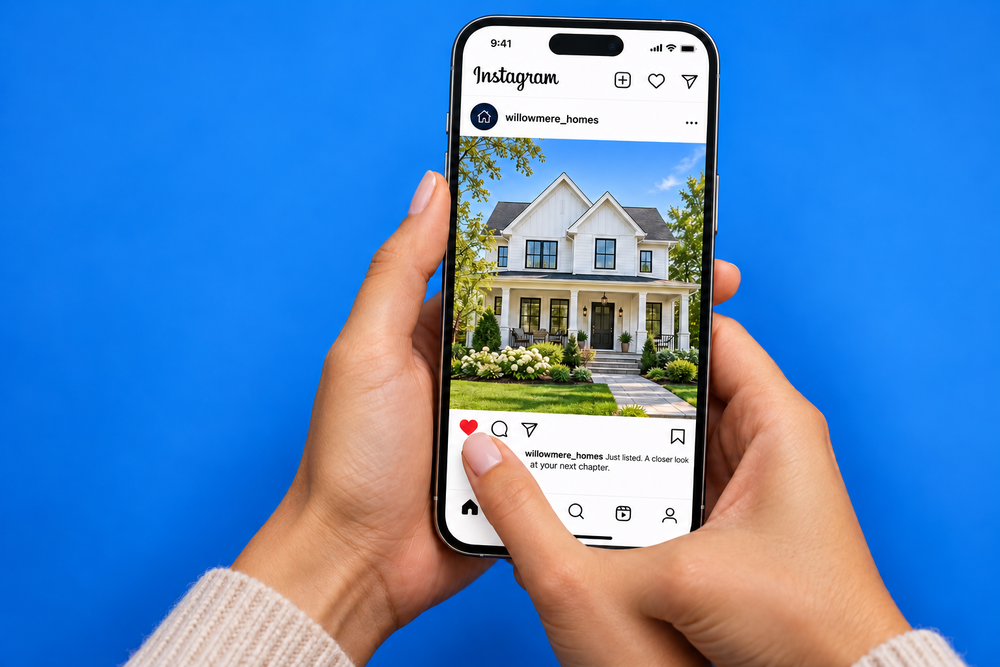
TL;DR: Instagram for real estate agents works when you show your market, your expertise and your properties visually, and keep posting in the weeks between listings. This guide covers profile setup, content categories, formats, local expertise, buyer and seller education and listing posts, explains how Instagram differs from Facebook and LinkedIn, and gives you a routine with ideas for every week. It also lists real estate Instagram accounts worth following and shows where Xara’s Social Media Manager keeps the feed going.
Is Instagram good for real estate agents?
Yes, for agents who can show their market, their expertise and their properties visually. Pew Research’s 2025 survey of U.S. adults found that 50% use Instagram, and eight in ten adults ages 18 to 29 do, far more than older adults. That makes it a natural home for first-time buyers and younger homeowners, along with plenty of people outside that group.
The goal is for people in your market to understand three things: where you work, what you know and what it’s like to work with you. Trust is the currency of a real estate business, and Instagram lets real estate professionals earn it in public.
A property tour on Monday, a market snapshot on Wednesday and a neighborhood spotlight on Friday show potential clients how an agent works before they ever call.
Instagram is rarely where someone decides to hire an agent. They might find you through a neighborhood Reel, visit your profile a few times, watch you explain a market change and remember your name when they’re ready to move.
The same feed keeps a real estate agent easy to remember: a recognizable face, a recognizable layout and a real estate market that people associate with one name.
It also rewards what real estate has plenty of: homes, neighborhoods, before-and-afters and a face people can learn to recognize. No post is guaranteed to produce an inquiry, but a steady account is real estate marketing that works while you’re at a showing.
Agents who use Instagram well usually do three things: they post a recognizable mix of content, they reply to every comment and DM, and they follow a few accounts for fresh angles. This article builds each habit step by step, starting with how Instagram differs from the other platforms agents use.
How Instagram differs from Facebook and LinkedIn in social media marketing
A real estate Instagram feed works differently from a Facebook page or a LinkedIn profile, and agents who treat them the same usually end up with weak posts on all three.
| What people come for | Visuals, discovery and a quick sense of the person | Local conversation, groups and your existing network | Professional contacts and referrals |
| Caption style | Hook first, short, the visual does the work | Longer and conversational, often ending on a question | Professional, with a clear takeaway |
| Where to learn more | This article | Facebook for real estate | Hub |
Take a market update. On Facebook it gets the longer explanation and a question at the end. On Instagram it becomes a three-slide carousel, and on LinkedIn it becomes the professional takeaway.
Instagram strategy for real estate agents
A good social media strategy answers five questions: who you serve, what you know, where you’ll show it, how often and how you’ll check it’s working. The sections below turn the habits above into a routine.
Set up your professional account
Switch to a business or professional account to unlock Insights, contact buttons, scheduling and ads. Your real estate agent Instagram profile has four parts that matter.
- Username and Instagram handle. Use your own name, since it travels with you when a realtor changes brokerages or moves markets.
- Photo. A clear, friendly headshot works better than a logo.
- Bio. Say who you help in real estate, where, a reason to trust you and what to do next. Example: “Austin real estate advisor. Helping first-time buyers find their first home. DM ‘BUYER’ for my checklist.”
- Link and buttons. Add the call, email and directions buttons, and one link to a page that matches what visitors want, such as a home valuation or buyer checklist.
Add your city or specialty to the name field, which Instagram search reads, and repeat it in your bio. Then group Highlights by what a visitor wants to find (New listings, Sold, Testimonials, Buyer tips, Seller tips) and pin three posts: who you help, your best video and how you work.
Build a content strategy around five categories
A simple content strategy covers five categories, which match the pillars in the hub.
| Category | What it shows | Best format | Example |
|---|---|---|---|
| Expertise | How you work and think | Reel or Story | “The one thing I check in a basement before a buyer falls for the kitchen” |
| Local knowledge | You know the area | Carousel or Reel | “What $600,000 buys in three neighborhoods” |
| Buyer and seller education | Answers to real questions | Carousel or Story | “Accepted offer to closing in six stages” |
| Market context | What the numbers mean here | Carousel | “Inventory this month: one number, one meaning” |
| Listings | The properties you’re selling | Carousel, Reel or Story | “One detail the photos don’t show” |
Use Reels, carousels and Stories

- Carousels explain and often get saved: market numbers, timelines, checklists and before-and-afters.
- Instagram Reels tour and show personality: one room, one neighborhood corner, one tip in under a minute that keeps viewers watching.
- Instagram Stories feel like a quick message: open house countdowns, polls and question boxes that keep people engaged. A link sticker sends people to a property or booking page.
- Live video works for a Q&A or a virtual open house, announced a few days ahead.
Authentic usually beats polished on Reels and stories, so a clean phone clip with good light is enough. Check music and media rights before posting promotional videos.
A carousel works best when the idea has steps. A five-slide example: what happens after a seller accepts your offer, earnest money and deadlines, inspection and due diligence, appraisal and financing, and preparing for closing. Keep each slide to one idea.
Show your local expertise
Local knowledge is the clearest way to stand apart from every other agent with a similar property.
- Price-point posts. “What $600,000 buys in [neighborhood A], [B] and [C]” gives buyers a reason to save the post and gives you a reason to talk about each area.
- Neighborhood spotlights. A coffee shop, a park, a school change, the farmers market that moved. Tag the business and the location.
- New in town. A new restaurant, an approved development or a reopened road, with your take on it.
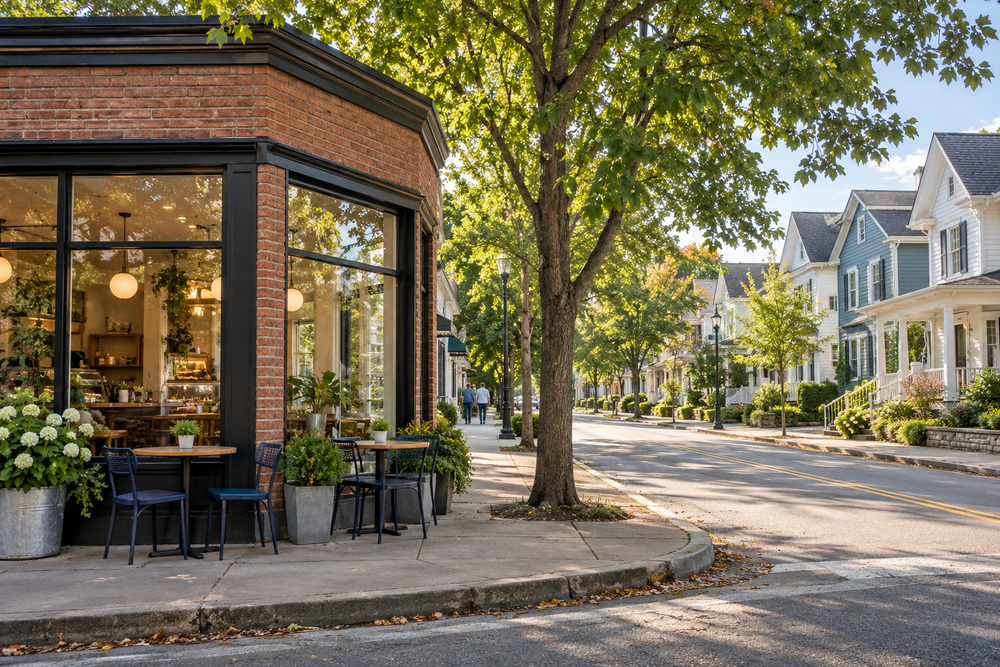
Keep descriptions factual and inclusive. Fair Housing rules apply to housing-related posts, so describe what’s there and skip lines about who a neighborhood is “for.”
When you post market numbers, add the reporting period, the area and the source. A graphic with only a median price gives people a number, and one sentence of context, such as “more homes for sale this September than last September, though conditions vary by neighborhood,” gives them understanding.
Keep your real estate branding consistent
Colors, fonts and layout repeat, so a post is recognizable before anyone reads the name. Branding works through repetition. Pick a palette and a layout, add your face and name to the template, and keep them for months.
Real estate education: teach buyers and sellers something
Anything you’ve explained three times to real estate clients can become a short Reel, a carousel or a Story.
For buyers, cover how pre-approval differs from pre-qualification and what happens after an accepted offer.
For sellers, cover what to fix before photos, how pricing works and what the first two weeks on the market look like. Point readers to reliable sources on financing and contracts, and keep individual advice for conversations.

A simple Reel structure is hook, one idea, next step: “Thinking of selling this spring? Here’s the one thing I’d do first” (hook), “Declutter the entry and the kitchen counters, because they show up in every photo” (idea), “Want my full checklist? DM me CHECKLIST” (next step).
Education posts are also the easiest to repeat, because clients keep asking the same questions. One strong answer can become a Reel, a carousel and a Story, which is how a busy realtor keeps a marketing routine going without starting from scratch each week.
Showcase listings without repeating the MLS
Real estate listings are the most concrete content you have, so make each listing on Instagram count: put the status first.
Open with Just Listed, Open House, Price Update, Under Contract or Sold, because only the start of a caption shows in the feed.
Lead with one detail the photos don’t show, such as the south-facing yard or the roof replaced last year.
Vary the format: one property can be a carousel of its best photos, a 20-second Reel of a single room, a Story countdown to the open house and a Highlight once it sells.
Example caption: “Open house Saturday, 1 to 3. 14 Alder Court has a fenced south-facing yard and a kitchen that opens straight onto it. Swipe for the layout, DM me for a private tour.”
Invest in photography and real estate video

Real estate photography is where to spend on quality, because listing photos are what buyers judge first. Professional photography and quality photography pay off on every property, and a steady phone clip with natural light and a tripod covers the rest. A single-room video often does more than a long montage with no context.
Search, hashtags and location tags
Instagram SEO starts with the name field, the bio and the first line of a caption. Use a few hashtags that fit the post and your area, since several widely followed accounts use few or none. Name the place in captions: “the Austin market,” “three places to explore in Round Rock.” Add a location tag on property and neighborhood posts, because it helps local people find them.
Work with influencers and local businesses
Local influencers, from home-design creators to community pages, reach people you don’t. Local influencers also tend to know which neighborhoods are changing. A joint Reel with a coffee shop, a lender or a stager shows your target market a familiar face, and tagging the partner puts the post in front of their followers too.
Get permission before filming or featuring anyone, invite them to an open house or a neighborhood walk, choose partners whose values match yours, and tell people when a post is a partnership. Viewers notice when a recommendation is real.
Write Instagram captions that get read
A caption has one job in the feed: earn the tap on “more.” Put the status or the hook in the first line, give the useful detail in the next two, and end with one clear next step. For a real estate listing that might be the status, the standout feature and “DM me for a private tour.”
For education it’s the question, the short answer and “save this for later.” Keep your voice the same from bio to caption, because people follow people on Instagram.
Short paragraphs read better on a phone than one block, and a good first sentence does more work than an emoji.
Handle Instagram DMs like a conversation
Many Instagram inquiries start in the DMs: a reply to a Story, a comment on a Reel, a question about a property. Reply the same day, answer the question first and move to a call or a showing when the person is ready.
Follow up once with something useful, such as the checklist you promised, and skip copy-pasted pitches. Potential clients can tell within a sentence whether they’re talking to a person or a script.
Save replies for the questions real estate agents hear every week, and personalize the first line of each. Follow local businesses and neighbors back, too, since those relationships often lead to referrals.
Repurpose one idea across Instagram, Facebook and LinkedIn
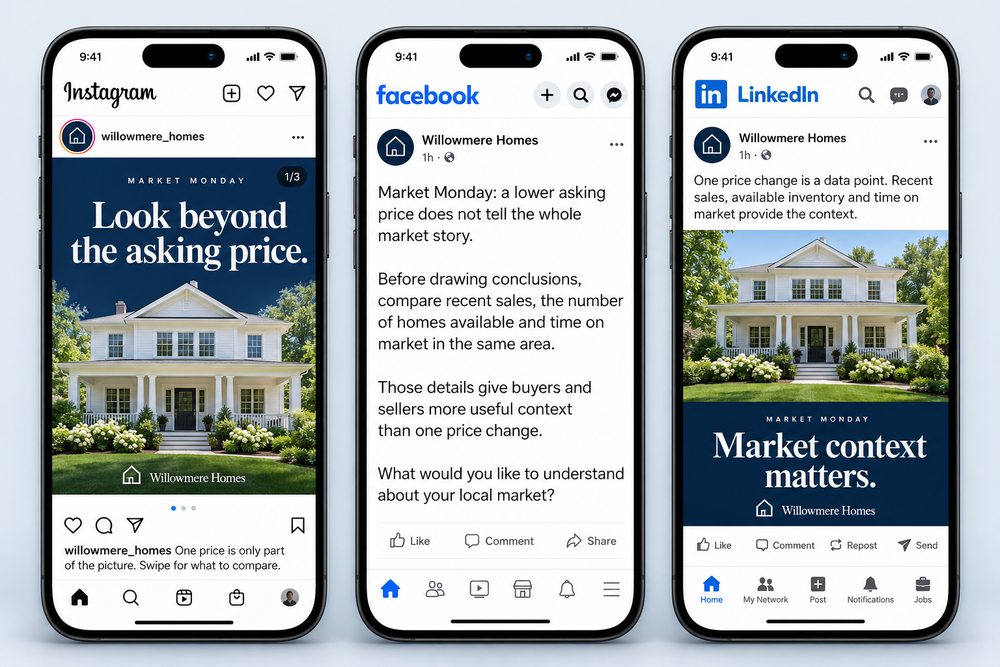
One idea can travel. A market update becomes a three-slide carousel on Instagram, a longer explanation on Facebook and a professional takeaway on LinkedIn.
Film one tip, post the Reel on Instagram and share the same video on Facebook with a longer caption. Use the same series names on every platform so your audience recognizes them.
Agents who run all three get more from each idea and spend less time on new ones. Our Facebook guide covers the second platform in detail.
Instagram marketing and advertising
Paid promotion sits on top of your organic real estate content. Boosting a post that already works is a quick way to reach more local potential customers, and Meta’s Ads Manager gives you more control. Instagram advertising for housing carries special requirements, including limits on targeting, so check Meta’s current rules first. Our article on paid ads for real estate covers the detail.
Instagram for a brokerage or real estate team
A brokerage can run one main account and encourage each realtor on the team to run their own. The brokerage account works best as a showcase for agent spotlights, milestones and local news, while each agent’s feed carries their personal voice and listings.
A team gets the most from a shared set of colors and a shared set of series, so the marketing is recognizable everywhere it appears. Shared branding across the team’s feeds does the rest.
Agents on the team follow the main account, tag it in their own posts and share its spotlights to their own feeds, so every post helps the others.
Your first 30 days on Instagram
- Week one: set up. Switch to a professional account, write a bio that names your real estate market and add your contact buttons.
- Week two: research. Follow 10 real estate profiles from the accounts section below, save the posts you’d adapt and write down the first line of each.
- Week three: produce. Film two Reels and build two carousels in one sitting. Batching content creation like this gives you the month’s first series.
- Week four: review. Open Insights, find the post that earned the most saves and replies, and plan the next month around it.
About three hours a week runs this Instagram strategy, and every real estate agent can fit it in alongside showings.
Marketing tips: how often to post and what to measure
There’s no proven frequency. Three feed posts a week is a workable start, which is the low end of the three to five a week that most guides suggest.
Open Insights once a month and look at saves, shares, profile visits, link taps and DMs, the numbers that show which Instagram posts are doing real work for your real estate marketing.
Match the numbers to your goal: reach and profile visits for awareness, saves and shares for useful education, DMs and link taps for inquiries. A smaller audience that lives in your market can be worth more than thousands of followers elsewhere. Ask every new client how they found you, because Instagram doesn’t tell you which post led to which call.
Common mistakes on a real estate agent’s Instagram
Most real estate agents who stall on Instagram make the same few mistakes, and each one is easy to fix.
- Posting only property updates. A feed of nothing but real estate listings reads like a billboard. Add education, local posts and personality, and give potential clients a reason to follow you between transactions.
- Skipping the bio and link. A visitor who likes one post should learn in seconds who you help, where you work and how to reach you. One clear link to a landing page does more than a menu of six.
- Changing the look every week. Pick colors, fonts and a layout and keep them. Recognition on Instagram builds through repetition.
- Never replying. Comments and DMs are where Instagram turns viewers into conversations, so reply the same day.
- Copying a style that isn’t yours. A humor account works because the person is funny. Choose the lane that fits you, whether that’s education, local knowledge or personality, and stay in it.
Agents who fix these five find that the marketing basics are already in place. The rest is a routine.

Instagram ideas for real estate agents: keep the account useful between listings
Agents do best when they have a plan for the weeks between listings. Naming three or four series gives you post ideas on repeat.
| Series idea | Format | What it covers |
|---|---|---|
| Market Monday | Carousel | One local number and what it means |
| 60 Seconds with [your name] | Reel | One buyer or seller question |
| Neighborhood Friday | Reel or carousel | One spot, one price point or one local event |
| Ask me anything | Story question box | Questions from followers, answered in the next Stories |
| Sold story | Carousel | One closing, told with the client’s permission |
A simple week could run like this: a Market Monday carousel, a Tuesday poll in Stories, a Wednesday Reel, a Neighborhood Friday post or a listing with one standout detail, and open house Stories at the weekend. Strong success stories make good real estate Instagram posts too, when the clients agree.
Good Instagram posts for realtors
A good post for a realtor starts with a question a client really asked. These formats earn saves and replies:
- A price-point carousel: what a set budget buys in three neighborhoods.
- A myth-and-fact post, such as “You need 20% down” or “Spring is the only time to sell.”
- A one-room Reel of a current property with the one detail photos don’t show.
- A checklist carousel: what to fix before photos, or what to ask at a showing.
- A before-and-after of the prep work behind a successful sale.
- A local guide: three places in your area, with a location tag on each.
For more material, see our 59 posts to try, and the 30-day calendar puts a month of them in order. Keep a running list of the questions clients ask, because that list is your content bank. Reply to comments and DMs the same day, and invite action in the comments. “Comment HOMES and I’ll send you the list” works when you really send it.
Real estate Instagram accounts to follow for inspiration
Following good real estate Instagram accounts is a quick way to find ideas for your own, because they show the habits above in practice.
Each profile below gives the Instagram handle and one habit worth borrowing. Handles and content change, so check each profile first. Pick a handful, give each a job (education, local posts, humor) and save the posts you’d adapt. Add a few local real estate accounts too, such as the city and nearby businesses. Some of these are agents, and some are influencers in their own right.
Across the real estate industry, these profiles share the same few habits: a clear niche, consistent branding, recurring series, local knowledge and personality.
Katie Lance
A social media coach for real estate agents and brokers, behind the #GetSocialSmart Academy. Borrow this: a daily slot for meaningful comments and replies before you post anything new.
Bryan Casella
Instagram handle: @bryancasella
Tips for agents, from negotiating to handling difficult clients. Borrow this: answer the questions clients ask in the middle of a deal.
NAR Research
Instagram handle: @narresearch
Housing data turned into infographics. Borrow this: add a call to action such as “DM me for the stats on your local market.”
For the Love of Old Houses
Instagram handle: @fortheloveofoldhouses
Historic homes from around the country. Borrow this: a single niche can carry a whole feed.
StreetEasy
Instagram handle: @streeteasy
Price-point posts, such as what $800k gets you in a named neighborhood, from condos to houses. Borrow this: what a set budget buys in three of your areas.
Ken Pozek
Instagram handle: @kenpozek
Orlando’s go-to local real estate source. Borrow this: post what’s opening, closing and changing first.
Caleb Simpson and the street interview
Instagram handle: @calebwsimpson
Interviews with strangers about where they live. Borrow this: interview-style videos break up a feed of tours.
Barry Cohen Homes
Instagram handle: @barrycohenhomes
High-end photography with a signature font and logo on every post. Borrow this: one layout for every property listings post, so the details are easy to find.
The Real Brokerage
Instagram handle: @realbrokerage
Brokerage marketing that blends agent spotlights, milestones and education. Borrow this: a regular spotlight for agents and clients.
Zillow
Worth reading for its captions on real estate listings, as McKissock’s roundup suggests. Borrow this: study the first line of each caption.
The Broke Agent
Instagram handle: @thebrokeagent
Real estate comedy by Eric Simon. Borrow this: one joke about the job breaks up the Just Listed posts.
Ryan Serhant
Instagram handle: @ryanserhant
Personality-led, fast-paced video with behind-the-scenes humor. Borrow this: keep videos quick.
Shelton Wilder
Instagram handle: @sheltonwilderestates
A luxury real estate agent in Los Angeles who features her properties, promotes her podcast and shows the humorous side of the industry. She has filmed a “Wilder Wednesday” video every week since 2017. Borrow this: one weekly video with a name and a day.
Where Xara’s Social Media Manager fits
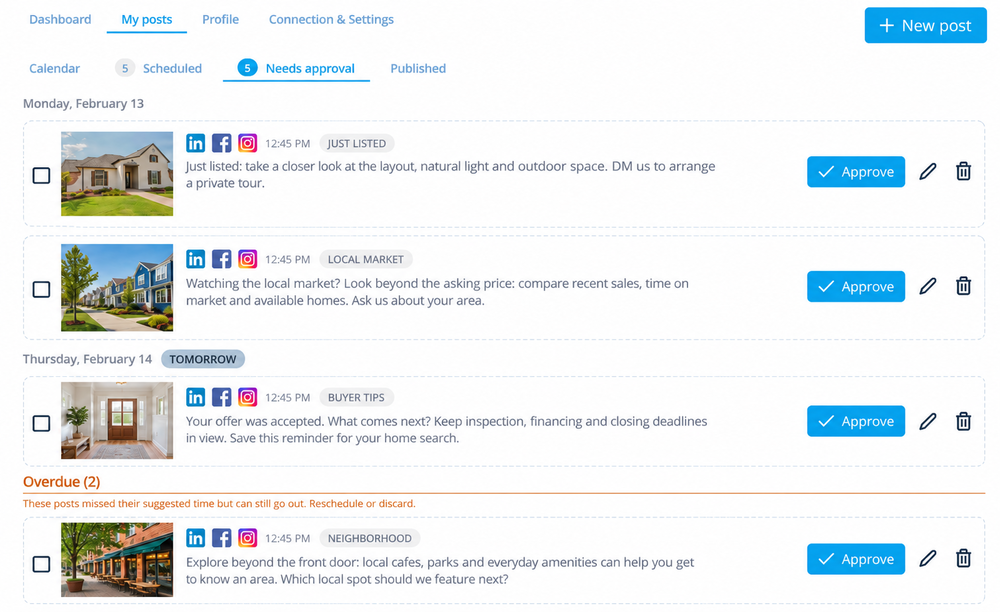
Xara’s Social Media Manager keeps Instagram going with two kinds of posts. When a home’s status changes, Xara already creates and posts the matching content: Just Listed, Open House, Price Reduction, Under Contract and Just Sold. Between those moments, Social Media Manager researches topics from your real estate market, audience, listings and brand, and fills the calendar with local real estate market content, neighborhood information, and buyer and seller education.
How your posts stay varied
The calendar draws on several content categories, so a week mixes a market update, an education post, a neighborhood post and a property post. Captions are written for Instagram separately from Facebook and LinkedIn, and the visuals follow your brand rules, so your posts look consistent without all looking alike.
What you control
You decide whether each post waits for your approval or goes out automatically. You and your admins can edit or remove anything in the queue.
What stays with you
Reels shot at a property, Stories from an open house, replies to comments and DMs, and the personal posts that sound like you. Social Media Manager covers the repeatable posts so your time goes to those. Xara doesn’t track which post led to which inquiry, so use Insights and ask new clients how they found you.
What does this look like for real estate teams?
Customers describe the effect in their own words. On Xara’s customer stories page, Broker Associate Shawna H. wrote in her G2 review:
“Xara supercharged my real estate social media engagement and branding.”
She added that the social media manager “increased my engagement across multiple platforms in a short period of time.” That’s one customer’s experience, and results vary for every agent.
For a brokerage view, Collier & Associates has more than 250 agents in Northwest Arkansas. According to its customer story, about 1 in 3 Price Improvement and Under Contract campaigns and more than 1 in 5 Open House campaigns are posted automatically to agents’ social profiles, often while the agent is out with clients or at a showing. Across all of its campaigns, 31% are posted automatically. Founder and Principal Broker Stuart Collier puts it this way:
“We have every kind of agent, from top producers to part-timers, and now marketing goes out for all of them, on brand, on the moments that move a sale.”
At Westgate Realty, which equips 60 agents with custom content every day, the marketing team saves 80 hours a month, according to the story on Xara’s customer stories page. These figures describe listing marketing across each brokerage, not Instagram-only results.
Frequently asked questions
What are the best Instagram accounts for real estate agents?
It depends on what you want to learn. The profiles above give you a starting point for each job: education and tips, data, local expertise, listings and brand, and personality. Follow one or two from each and keep the ones that teach you something.
Is Instagram good for real estate agents?
It suits real estate agents who can show their market and their properties visually, and it reaches many first-time buyers and younger homeowners. It starts conversations and builds trust with local people, but no post is guaranteed to produce an inquiry.
What are some good Instagram posts for realtors?
A price-point carousel, a one-room Reel, a Story poll, a myth-and-fact post, a Just Sold story with the client’s permission and a weekly series with a name. Our 59 posts to try have plenty more.
How do agents get clients from Instagram?
Instagram helps people discover an agent, see their expertise and start a conversation. Make your market and contact details clear, post useful content and reply quickly to inquiries. No post is guaranteed to generate a lead.
Are Reels better than Instagram posts for real estate?
Not universally. Reels suit tours and demonstrations, carousels suit checklists and comparisons, and quick Story posts suit timely updates. Use the format that serves the idea.
What is the 3-3-3 rule in real estate?
There’s no single official version. One widely reported version, covered by RISMedia and Florida Realtors, asks agents to call three people, send three handwritten notes and share three useful resources each month.
How often should real estate agents post on Instagram?
Three feed posts a week is a workable start, plus quick updates when you have something to show. Pick a rhythm you can keep and let Insights steer changes.
Give your Instagram a routine
Pick a few profiles for real estate inspiration, choose your series and decide what the repeatable posts are. Then spend your time on the marketing only you can do: the showings, the conversations and the replies.
See how Xara plans, creates and schedules Instagram posts for your listings and your market.



 No credit card or phone number required.