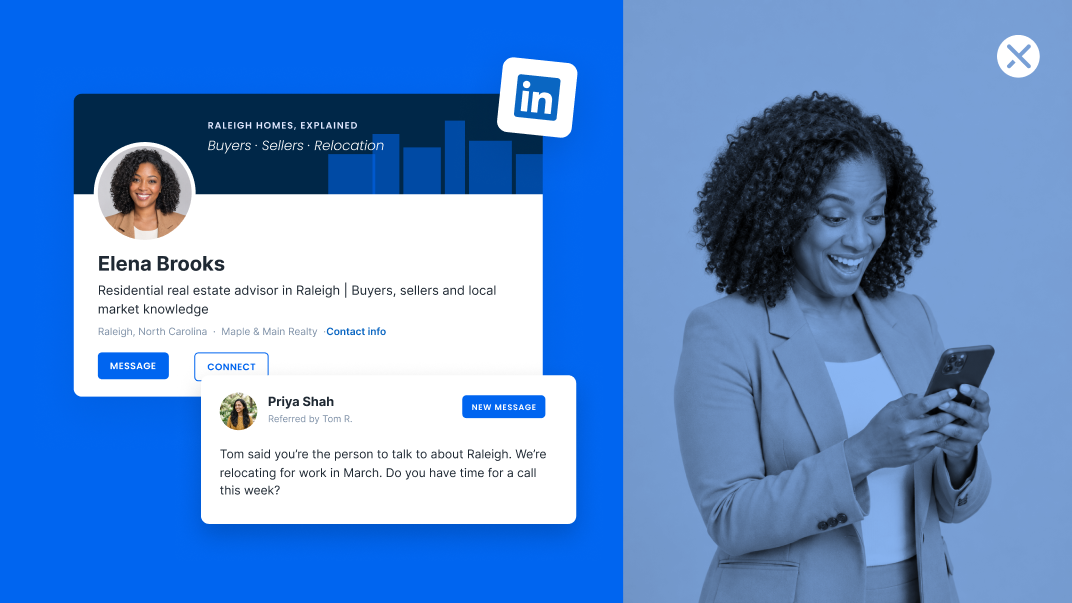
TL;DR: LinkedIn helps real estate agents build a professional brand, connect with local clients and partners and get found by buyers and sellers. A clear profile, a relevant local network and a routine you can keep matter more than follower counts. This guide shows how to set up each one.
LinkedIn is where lenders, attorneys, relocating professionals, past clients and local business owners keep their professional profiles. Some buyers and sellers also look an agent up there before they get in touch.
For a real estate agent, that makes LinkedIn a place to build your professional brand, stay connected with the people around your business and be easy to find and contact.
This guide shows how to build a profile that makes people want to get in touch, grow a network of relevant local people, decide what to post and keep a routine going in a busy month.
A clear profile, the right connections and posts that show how you think about real estate are enough to start.
Is LinkedIn good for real estate agents?
Yes, particularly when your business depends on professional relationships, referrals or contacts who use LinkedIn regularly.
It helps you stay in touch with past clients, build relationships with lenders and attorneys, meet local entrepreneurs and reach professionals relocating to your area.
The research is narrower than most articles suggest. In NAR’s 2025 REALTORS® Technology Survey, 75% of Realtors said they use social platforms and 39% said those tools produce their highest number of quality leads. The survey does not break the figures out by platform, so LinkedIn’s share is unknown.
The Real Brokerage’s April 2026 agent survey of 569 agents found that 60% named referrals and repeat clients as their most effective source of business, and 17% named social media.
LinkedIn is built for the referral side of that picture.
What LinkedIn can help you achieve
| Goal | How LinkedIn helps | Example |
|---|---|---|
| Build professional credibility | Shows your background, knowledge and track record | A seller checks your profile after receiving a referral |
| Develop referral relationships | Keeps you connected to professionals who serve the same kinds of people | A lender remembers you when a client needs an agent |
| Reach relocating professionals | Connects you with people moving for work | An employee transferring to your city asks about the local market |
| Show local knowledge | Gives you space to explain trends and decisions | A local owner reads your analysis of housing supply in the area |
If you are deciding where to invest your time, ask whether the people who influence your business are active on LinkedIn.
If they are, it deserves a place in your marketing mix.
LinkedIn vs. Facebook vs. Instagram for real estate
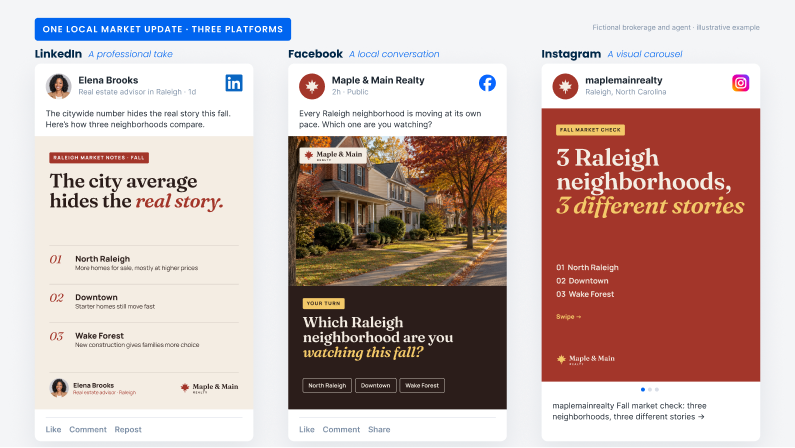
Each platform rewards something different. A property tour that works as an Instagram Reel needs a different angle to be useful on LinkedIn.
| Platform | Main opportunity | Content that fits |
|---|---|---|
| Professional credibility, relationships and introductions | Market perspective, industry insights, educational posts, professional milestones | |
| Community connections and local conversations | Neighborhood updates, events, longer explanations, property news | |
| Visual discovery and property storytelling | Reels, carousels, tours, Stories and local visuals |
AI-generated image
Imagine you want to share a local market update. On Instagram, you might create a carousel comparing inventory across three neighborhoods. On Facebook, you could explain what changed and invite local questions. On LinkedIn, you might write about what the change means for professionals relocating to the area or homeowners considering a move.
The market data can stay the same in all three posts while the angle changes with who is reading and what they care about.
Our articles on Facebook for real estate agents and Instagram for real estate agents cover those channels in detail.
A guide to building a LinkedIn profile that makes people want to contact you
A real estate LinkedIn profile is often read in seconds, so it should answer three things quickly:
- Who you help
- Where you work
- Why someone should trust you
If visitors have to dig through the page to find those answers, it needs work. These profile tips work together.
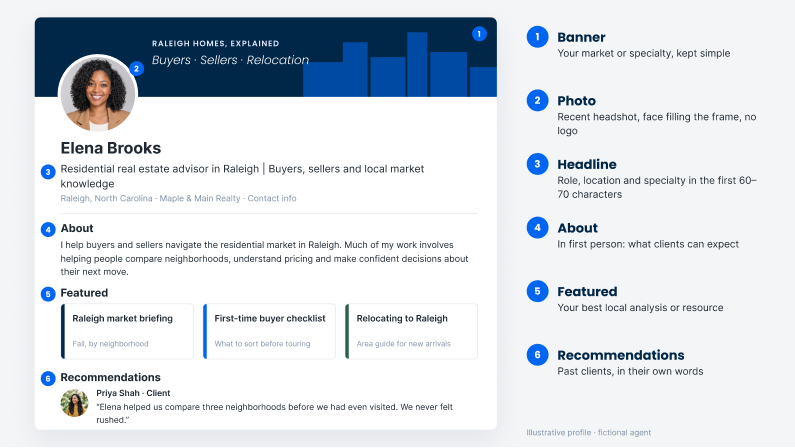
Photo and banner: branding that fits your market
Choose a professional profile photo: a recent professional headshot with your face filling most of the frame and no logo. The banner can reinforce your location or specialty. A clean image of your market or a simple graphic is enough.
Skip tiny text that becomes unreadable on mobile.
A headline that explains what you do
Your headline shows next to your name in search, on connection requests and beside every comment you leave. Many views show only the first 60 to 70 characters. “Real Estate Agent” is accurate but says little about your market or the clients you serve. A better headline combines your role, location and specialty.
Examples:
- Real estate agent in Austin | Helping first-time buyers navigate their first purchase
- Denver Realtor | Relocation and residential property
- Residential real estate advisor in Raleigh | Buyers, sellers and local market knowledge
- Real estate agent serving Tampa Bay | Condos and investment properties
Use credentials and performance claims only when they are accurate and current.
Include natural search terms such as your city and “real estate agent,” and stop short of a string of keywords.
Your About section and experience section
Your About section does not need to read like a corporate biography. Write in the first person and explain what clients can expect from working with you.
A fictional example:
“I help buyers and sellers navigate the residential market in Raleigh. Much of my work involves helping people compare neighborhoods, understand pricing and make confident decisions about their next move. If you are considering a move or have a question about the area, you are welcome to get in touch.”
Add credentials people can verify. Complete your work history with your company, the markets you serve and your areas of practice. Add licenses and certifications in their own section, and add skills that match how clients describe you.
Use Featured content to show your work. Good starting picks:
- A recent, well-sourced local market analysis
- A buyer or seller resource you have created
- A client-approved testimonial or professional introduction
Ask for specific recommendations. Ask past clients to describe working with you in their own words, and leave the wording to them.
Quick check: a new visitor should find your market, specialty and contact details within moments.
AI-generated image
Build a LinkedIn network that can lead to real relationships
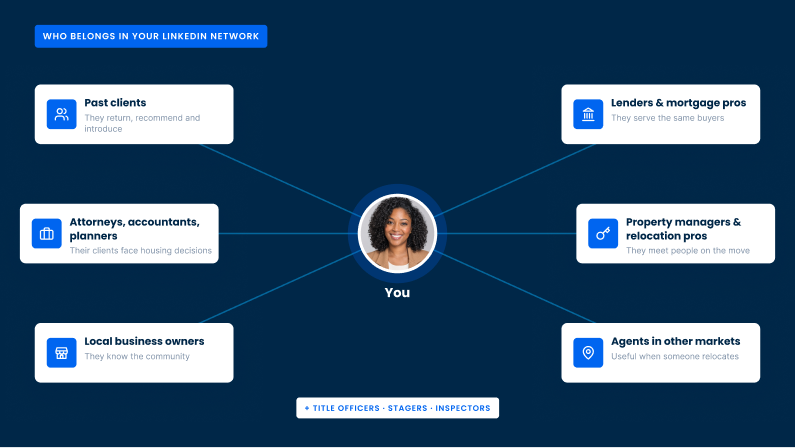
A large network is not automatically a useful one. For real estate agents, 200 relevant local connections can be worth more than thousands of people with no tie to your market. Start with people you already know, then expand with intent.
| Connection type | Why the relationship matters |
|---|---|
| Past clients | They may return, recommend you or introduce colleagues |
| Local lenders and mortgage professionals | They may serve people with overlapping needs |
| Attorneys, accountants and financial planners | The people they advise may face housing decisions |
| Property managers and relocation professionals | They work with people moving into or around your market |
| Shop and company owners | They help you understand and join the community |
| Agents in other markets | They may be useful contacts when a buyer or seller relocates |
AI-generated image
That group is your referral network in practice, and many referral leads begin with a note to someone you already know.
Other real estate professionals, such as title officers and stagers, belong in it too.
Choose your target audience
Decide who you want to be known to: referral partners in one town, professionals relocating to your market or small investors. Connect with other agents in your market too, and add professional connections who work with the same kinds of people you do. Look for a genuine reason to know each person.
Personalized outreach: connection requests that get a reply
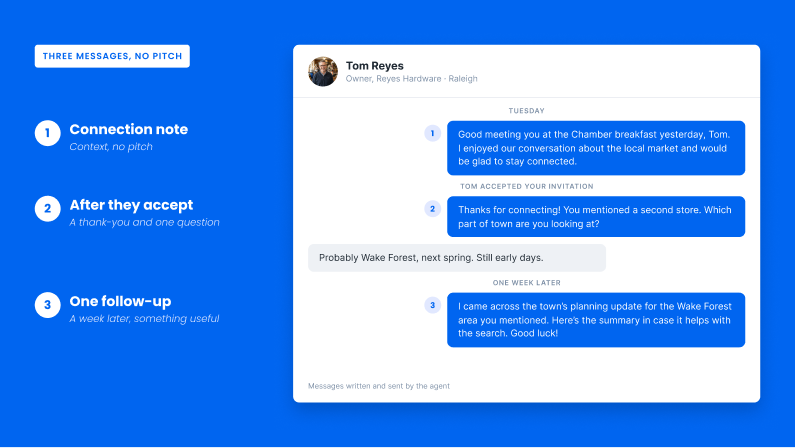
A connection request needs a little context and no pitch. Fictional examples:
- After a local event: “Good meeting you at the Chamber breakfast yesterday. I enjoyed our conversation about the local market and would be glad to stay connected.”
- To a professional whose content you found useful: “I saw your post about first-time buyer financing. I work with buyers in the Raleigh area and appreciated the explanation. Happy to connect.”
- To a former client: “It was great working with you on your move. I would love to stay in touch here.”
The goal is to begin a professional relationship.
Pro tip: base the note on something the person actually posted or did, because people answer messages that show you looked.
After someone accepts: a personal outreach sequence
AI-generated image
Keep it short. Thank them for connecting, and if they have posted something recently, mention it or ask a related question. If there is nothing natural to say yet, stay connected and engage with their posts when you have something useful to add.
A sales message the moment someone accepts turns a relationship into a transaction.
Comments help too. When a local leader shares news about an office expansion, add an accurate observation about the area’s housing market.
Skip “Great insights!” on every post. A few genuine contributions are worth more than many empty ones.
What to post: professional expertise and market perspective
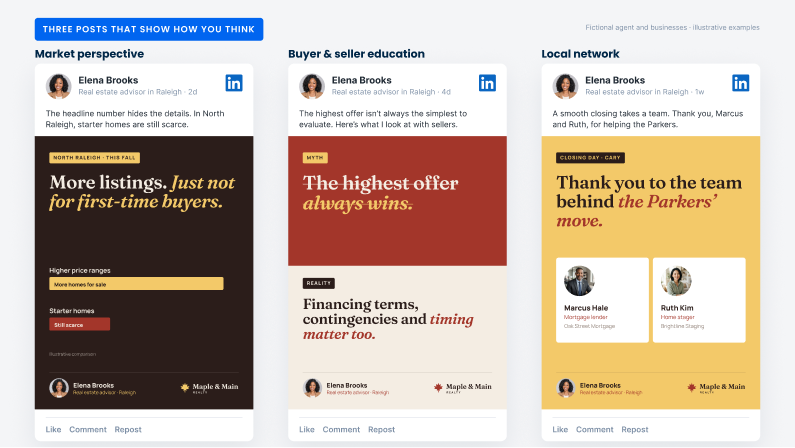
The best LinkedIn posts give people a reason to trust your judgment. A strong real estate agent post opens with the point and ends with an invitation to reply. They do not need to be formal or technical. Readers should come away knowing something useful about your market, your work or your perspective.
The examples below are fictional, with placeholders you should replace with accurate local information.
Market insights and updates
A market update should explain something as well as show a number. Market updates built the same way each month teach readers when to expect you.
Add the source, the area and the reporting period.
- Opening: “The headline number does not tell the whole story about our local housing market.”
- Body: “Inventory in [area] changed by [verified amount] compared with [period]. By price range the picture is more complicated: [one accurate difference].”
- Closing: “If you are considering buying or selling, look at the numbers for your own neighborhood, because the citywide average hides differences.”
Why it works on LinkedIn: it shows you can interpret information.
Buyer and seller education
Answer the questions you hear in real conversations. Short real estate tips on preparing a home for photos or reading an offer fit well, and so do lessons from your own work.
- Opening: “The highest offer is not always the simplest to evaluate.”
- Body: “Price matters, and so do financing terms, contingencies and the closing timeline. I help sellers compare the full terms.”
- Closing: “It is one reason I ask sellers about their priorities before offers arrive.”
For relocating buyers, try: “Moving to [city] for work? Compare commute times before you compare listing photos. I am happy to share what I use when helping people compare areas.”
Why it works: people see how you help others decide.
Local business network content
LinkedIn suits professional community relationships. Highlight a local opening or a verified development update, and explain why it matters to your audience. Thank the lender, stager or other real estate professionals who made a closing easier. Follow local influencers and community leaders and comment on what they share.
Client success stories work here too, told with permission and built around a decision or lesson.
If you work with investors, explain how you evaluate real estate investments in your market, and leave out promises about returns.
A fictional example: “A good listing presentation starts long before the photographer arrives. I spoke with [local professional] about preparing homes for marketing, and one takeaway was [specific, verified insight].”
Why it works: it shows you are connected to the market you serve.
Listing content where it fits
You can share listings on LinkedIn, but a photo and an MLS description rarely interest a professional network. Give the post a reason to exist: a distinctive property feature, an architectural detail or a note on how the price was set.
Keep descriptions accurate and inclusive, because the Fair Housing rules from HUD apply to housing content.
A fictional example: “This new listing shows why floor plans matter as much as photographs. The photos show the finishes, and the layout explains how the home works.”
For more topics, see our 59 social post ideas beyond listings.
Start a LinkedIn newsletter
A newsletter makes sense if you have a clear topic and can publish regularly, such as a monthly housing briefing for professionals relocating to your area or for referral partners. Build a few strong posts first, turn a strong blog post into an issue when it fits, and move to one when readers keep engaging with one topic.
AI-generated image
Cadence: a LinkedIn marketing strategy and weekly plan you can keep
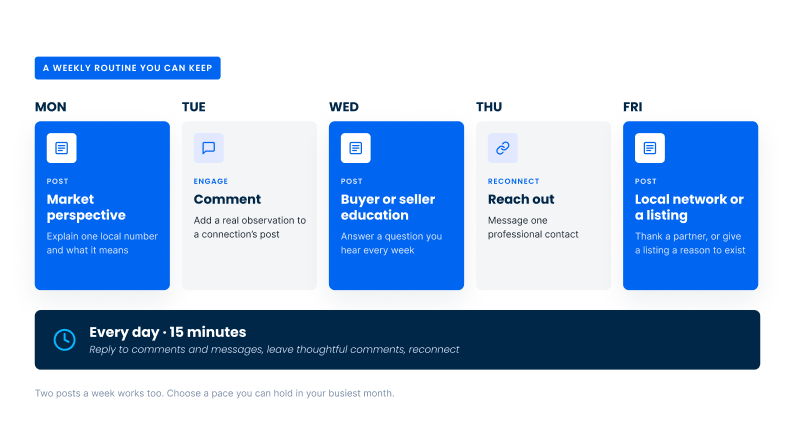
No schedule guarantees results. Two posts a week can start a useful routine, some real estate agents manage three, and others get more from one thoughtful post plus regular conversation. Choose a pace you can hold in your busiest month. Treat it as one part of your social media marketing across the other social media platforms you use and of your lead generation routine. Real estate marketing rewards the agent who stays consistent.
| Day | Activity | Example |
|---|---|---|
| Monday | Publish a market perspective | Explain one local statistic and its implications |
| Tuesday | Engage with your connections | Leave thoughtful comments on relevant posts |
| Wednesday | Publish educational content | Answer a common buyer or seller question |
| Thursday | Build relationships | Reconnect with a professional contact |
| Friday | Review and respond | Reply to comments, messages and open conversations |
Where leads on LinkedIn come from
Lead gen on LinkedIn: what to expect
Leads on LinkedIn usually start smaller than an inquiry form.
Someone comments on your market update. A former client introduces you to a colleague. A lender remembers your name. A relocating professional visits your profile after seeing a post.

AI-generated image
Each of these can open a conversation. LinkedIn converts attention into conversations when your profile and posts agree with each other, and the process is slow.
Treat it as one lead source among several. Leads from LinkedIn rarely arrive overnight, and warm leads usually come through a mutual connection.
Expect uneven lead conversion, and think of your potential leads as the people you want to be known to over the next year. Used patiently, LinkedIn keeps your real estate pipeline warm between transactions.
Make it easy for leads to reach you by showing your location, specialty and preferred contact method. A short relocation guide, market briefing or seller checklist can work as a lead magnet if it is genuinely useful.
For a wider look at real estate lead generation ideas across every channel, see our article on the topic.
Lead generation within LinkedIn’s rules
LinkedIn’s help center says it does not permit third-party software that scrapes its data or automates activity, and restricted accounts are asked to disable the tool before they are re-enabled.
Scheduling content and automating outreach are different activities. Check what a tool does before you connect it to your account.
LinkedIn groups, LinkedIn Sales Navigator and LinkedIn ads
Join a few local and real estate groups, answer questions and keep pitches out of the thread.
LinkedIn Sales Navigator is a paid prospecting tool that can suit a specialized audience. The free features are enough for most individual agents.
LinkedIn ads are worth testing when you have a defined audience and a useful offer, such as a relocation resource. Housing advertising is regulated, so read the platform’s policies before you spend.
How to measure whether LinkedIn is working
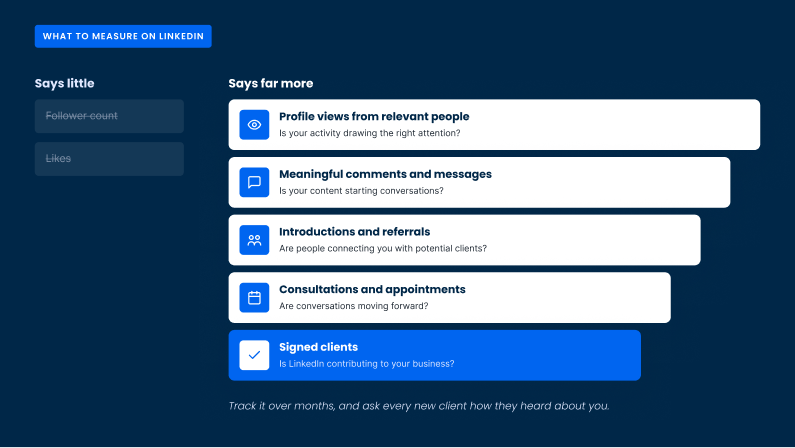
Follower growth can feel encouraging, but a smaller network of relevant local professionals can be worth more than a large audience outside your market. Measure what matters to your business, and judge conversion rates from profile view to conversation and from conversation to appointment over a longer period.
| Metric | What it helps you understand |
|---|---|
| Profile views from relevant people | Whether your activity attracts the right attention |
| Meaningful comments and messages | Whether your content starts conversations |
| Introductions and referrals | Whether people connect you with potential clients |
| Consultations and appointments | Whether conversations progress |
| Signed clients | Whether LinkedIn contributes to business outcomes |
Keep a simple referral record. When someone introduces you to a potential client, note who made the introduction and how the relationship developed. Note the source of your leads too.
Ask every new client how they heard about you. A person may see your posts, receive a referral and visit your website before calling, and no single post deserves all the credit.
Common LinkedIn mistakes and tips to avoid them
Most agents lose leads in the same few places, and each has a simple fix:
- Using the same captions everywhere. A Reel caption may not work as a professional LinkedIn post. Keep the topic and adapt the angle.
- Posting only property announcements. Listings show what you sell, while market explanations and education show what you know.
- Writing an unclear headline. Fix it before you post more.
- Pitching right after connecting. A connection is not permission for a sales sequence.
- Ignoring comments and messages. Posting opens conversations, and replying is part of the work.
- Using scraping or engagement bots. They put your account at risk and undermine real relationships.
- Making unsupported claims. Use reliable sources and avoid promises about outcomes.
- Disappearing for months. A routine you can keep beats an ambitious schedule you cannot.
Your first 30-day plan for LinkedIn
If you are starting from an inactive profile, use the first month to build a foundation.
| Week | Priority | What to do |
|---|---|---|
| 1 | Improve your profile | Update the headline, About section, work history, contact details and Featured content |
| 2 | Reconnect | Connect with past clients, colleagues and professional contacts you know |
| 3 | Publish | Share one local real estate market perspective and one buyer or seller education post |
| 4 | Build a routine | Respond to conversations, review what drew attention and set next month’s priorities |
At the end of the month, check:
- Can someone understand your specialty from your profile?
- Have you strengthened any useful relationships?
- Can you keep the routine going?
How Xara’s AI Social Media Manager supports a consistent LinkedIn routine
By now you have plenty of ideas for your LinkedIn presence. The hard part is keeping them going between showings, negotiations and closings.
Doing that across several platforms is a recurring task, and it gets harder when a brokerage supports many agents.
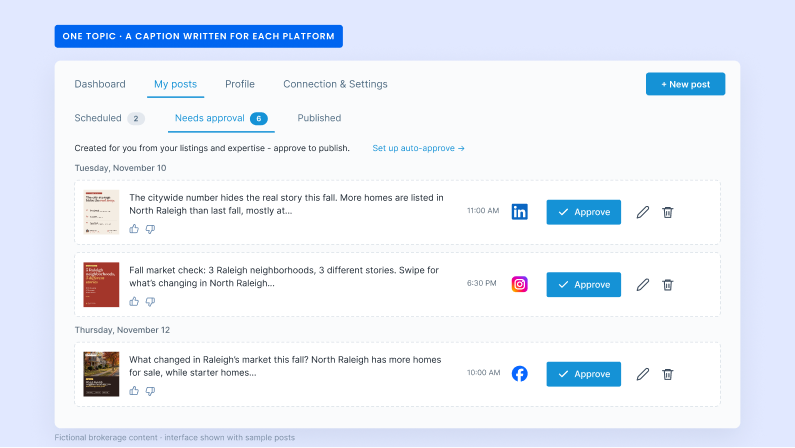
Xara’s AI Social Media Manager takes that recurring work off your plate. It builds a content calendar for each agent from their listings, sales, reviews and target locations, then posts local real estate market updates, neighborhood information and buyer and seller education to Facebook, Instagram and LinkedIn. You get local content without creating it yourself, and the people who check your profile find recent posts that show you know your market.
It writes the captions for each platform separately, so a market update reads like a professional note on LinkedIn and like a carousel caption on Instagram. A neighborhood spotlight, a short piece of buyer education and a local market update are the kinds of posts you will find in the queue.
Xara already creates and posts content when a home’s status changes, so listing milestones such as Just Listed, Open House, Price Reduction, Under Contract and Just Sold share one routine with everyday content.
You decide whether each post waits for your approval or goes out automatically, and you can edit or remove anything in the queue. Brokerages set brand rules once, and every agent’s posts carry them while agents personalize within those guardrails.
Your LinkedIn connections, recommendations and conversations with referral partners stay with you. Xara does not reply to comments or messages, and it does not track which post led to which inquiry. Social Media Manager is an add-on to Xara’s Real Estate plan.
For the full strategy across platforms, see the ultimate guide on our hub.
What does this look like for real estate teams?
Broker Associate Shawna H. wrote in her G2 review, which appears on Xara’s customer stories page:
“Xara supercharged my real estate social media engagement and branding.”
That is one customer’s experience, and results vary for every agent.
Collier & Associates has more than 250 agents in Northwest Arkansas.
According to its customer story, about 1 in 3 Price Improvement and Under Contract campaigns and more than 1 in 5 Open House campaigns are posted automatically to agents’ social profiles.
These figures cover listing marketing and are not specific to LinkedIn.
LinkedIn for real estate agents: FAQs
What is a good headline for a LinkedIn profile for a real estate agent?
One that names your role, location and specialty, such as “Real estate agent in Denver | Helping buyers and sellers navigate the local market.”
Use accurate credentials and natural keywords, and keep the key words in the first 60 to 70 characters.
Do real estate agents have LinkedIn?
Many do, though most posting effort goes to the visual platforms.
NAR’s 2025 survey reports overall use but not platform-level figures, so any exact LinkedIn percentage you see elsewhere is probably dated.
What is the 3-3-3 rule in real estate?
There is no single official version. One widely reported version, covered by RISMedia and Florida Realtors, asks agents to call three people, send three handwritten notes and share three useful resources each month.
A LinkedIn habit in the same spirit is commenting on three connections’ posts a day.
Can AI help manage LinkedIn for real estate agents?
AI can help draft posts, adapt them to each platform and support a publishing routine.
You still verify market information, add your own judgment and handle connections and conversations yourself.
Start with your profile this week
The goal is for people to understand what you do, recognize your expertise and feel comfortable introducing you to someone who needs an agent.
Rewrite your headline, update your About section and ask one past client for a recommendation. Then keep the routine manageable for your real estate business.
Book a demo to see how Xara keeps your posting going between listings, with your approval or automatically.





 No credit card or phone number required.